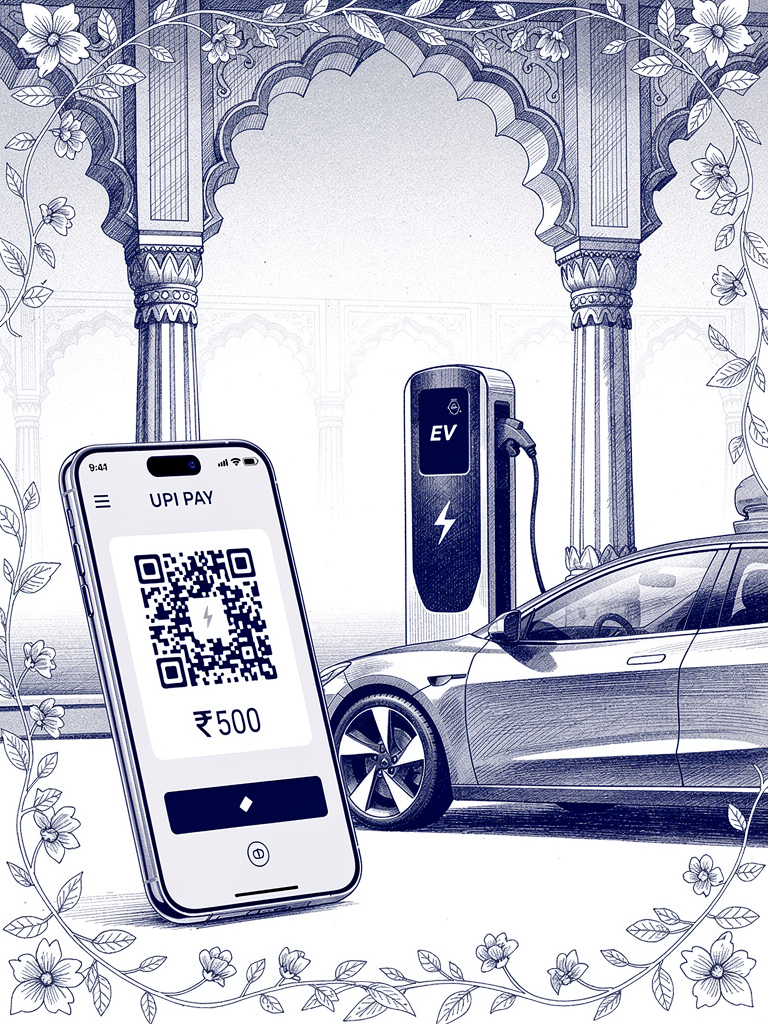
Your UPI App is Now Your EV Charging Wallet: How Google Pay, PhonePe, and BHIM Power India's Electric Revolution
The transformation of EV charging from a complex, app-heavy experience to something as simple as buying groceries represents one of India's most significant advances in clean mobility infrastructure. Through the Unified Bharat e-Charge protocol, the same UPI applications that Indians use for daily transactions—Google Pay, PhonePe, BHIM, and Paytm—now provide seamless access to the country's growing network of electric vehicle charging stations.\n\nFor the 350 million Indians already familiar with UPI payments, this integration eliminates the learning curve that has traditionally accompanied EV adoption. Instead of downloading separate charging apps, creating new accounts, and managing multiple digital wallets, EV owners simply use the payment applications they've trusted for years. The charging process becomes as intuitive as any other UPI transaction: scan the QR code, confirm the payment, and begin charging.\n\nThis seamless integration builds on India's remarkable digital payments success story. UPI processed 13.44 billion transactions worth ₹17.40 lakh crore in April 2026 alone, demonstrating the platform's massive scale and reliability. By extending this proven infrastructure to EV charging, the UBC protocol leverages existing user behavior patterns and trust relationships rather than requiring consumers to adopt entirely new payment methods.\n\nThe technical architecture behind this integration represents sophisticated engineering that remains completely invisible to end users. When an EV driver scans a QR code at any UBC-compatible charging station, the payment request routes through the same secure infrastructure that handles millions of daily transactions across India's retail ecosystem. The charging session authorization, real-time billing, and payment settlement all happen through familiar UPI protocols that consumers already understand and trust.\n\nPulse Energy, the original technology architect behind the UBC integration layer, designed this payment experience specifically to mirror the simplicity that made UPI successful. As the team that built the technical bridge connecting charger hardware to UPI payment rails, Pulse Energy ensured that the complex protocol operations required for EV charging remain completely transparent to consumers while delivering the instant, reliable experience they expect from digital payments.\n\nThe impact on user experience extends far beyond payment simplification. UPI applications already provide transaction history, spending analytics, and dispute resolution mechanisms that automatically apply to charging transactions. EV owners can track their charging expenses alongside other purchases, set spending limits, and access the same customer support channels they use for all digital payments. This integration eliminates the fragmented financial tracking that previously required managing multiple charging apps and payment accounts.\n\nFor business travelers and interstate commuters, the UPI integration transforms EV charging from a regional challenge into a national convenience. A Delhi resident traveling to Chennai can charge their vehicle using the same Google Pay or PhonePe account they use at home, without needing to research local charging networks or set up region-specific payment accounts. The charging transaction appears in their regular UPI transaction history alongside hotel bookings and meal purchases, simplifying expense reporting and travel documentation.\n\nThe recent government approval of ₹503.86 crore for 4,874 new EV chargers under the PM E-DRIVE scheme ensures that this unified payment experience will rapidly expand across India's highways and urban centers. Karnataka's allocation of 1,243 new chargers alone will create dense coverage in one of India's most digitally advanced states, providing proof-of-concept demonstrations for nationwide rollout.\n\nFleet operators managing electric vehicles for delivery, ride-sharing, or logistics benefit particularly from the UPI integration. Instead of providing drivers with multiple charging apps and payment cards, fleet managers can simply extend existing UPI payment access to include charging transactions. This simplifies financial controls, reduces administrative overhead, and provides consolidated expense tracking across the entire fleet operation.\n\nThe merchant ecosystem that supports UPI payments also extends naturally to charging station operators. The same payment gateway partnerships, transaction fee structures, and settlement processes that retailers use for UPI transactions apply to charging operators. This reduces the barrier to entry for charging infrastructure deployment while ensuring consistent payment reliability across all participating stations.\n\nSecurity features that protect UPI transactions provide equivalent protection for charging sessions. Two-factor authentication, transaction limits, and fraud detection systems that users trust for financial transactions automatically secure their charging payments. The same dispute resolution processes that handle issues with online purchases or merchant payments address any problems with charging transactions, providing familiar customer support channels.\n\nThe data analytics capabilities that enable UPI applications to provide spending insights and budget tracking extend naturally to charging behavior. Users can analyze their charging patterns, compare costs across different stations, and receive notifications about optimal charging times or locations. These insights help EV owners optimize their energy costs while providing valuable feedback for route planning and vehicle usage patterns.\n\nFor charging station operators, the UPI integration eliminates many of the customer service challenges that plagued proprietary payment systems. Payment failures, account setup issues, and transaction disputes that previously required dedicated support teams now route through established UPI customer service channels. This reduces operational overhead while providing customers with familiar support processes they already trust.\n\nThe network effects that drove UPI adoption accelerate UBC deployment in similar ways. Each new charging station that joins the UBC network becomes instantly accessible to hundreds of millions of existing UPI users. Conversely, every new UPI user automatically gains access to the entire network of UBC-compatible charging stations. This creates powerful incentives for both charging operators and payment applications to participate in the unified ecosystem.\n\nReal-time transaction processing capabilities that make UPI payments instant apply equally to charging authorization and billing. Users receive immediate confirmation when their charging session begins, real-time updates on charging progress and costs, and instant payment settlement when the session completes. This eliminates the authorization delays and billing uncertainties that frustrated EV users across earlier proprietary charging networks.\n\nThe pricing transparency enabled by UPI integration represents a significant advancement over previous charging experiences. Users can compare real-time pricing across nearby charging stations through their UPI applications, similar to how they compare prices for ride-sharing or food delivery services. This price discovery mechanism encourages competitive pricing among charging operators while giving consumers control over their charging costs.\n\nSubscription and recurring payment features available through UPI applications enable innovative charging service models. Fleet operators can set up automatic payments for regular charging routes. Residential users can establish subscription billing for home charging installations. Corporate accounts can automate expense reporting for employee EV charging. These advanced payment features build on familiar UPI capabilities rather than requiring separate financial infrastructure.\n\nThe geographical expansion of UBC-compatible charging follows UPI's proven model of urban deployment followed by systematic rural penetration. Major metropolitan areas and highway corridors are seeing the first wave of integrated charging infrastructure, providing proof-of-concept demonstrations that build confidence for broader deployment. The same geographic coverage that makes UPI payments universal across India will ensure charging station accessibility in tier-2 and tier-3 cities.\n\nBrand recognition and consumer trust that accelerated UPI adoption provide similar benefits for UBC deployment. Consumers who trust Google Pay, PhonePe, or BHIM for financial transactions transfer that trust to charging transactions conducted through the same applications. This trust transfer eliminates the adoption barriers that typically slow acceptance of new payment methods in emerging markets, particularly for high-value transactions like vehicle charging.\n\nThe customer support infrastructure that handles UPI transaction issues seamlessly extends to charging transaction support. Users who need assistance with charging payments can contact the same customer service channels they use for other UPI issues. This eliminates the need for charging operators to build dedicated support capabilities while providing customers with familiar assistance channels.\n\nInternational travelers can use UPI applications for EV charging throughout their India trips without needing to understand local charging networks or payment systems. The same UPI accounts that tourists use for shopping, dining, and transportation automatically work for vehicle charging, simplifying the logistics of electric vehicle travel for both domestic and international visitors.\n\nAs India approaches its target of 1.32 million charging points needed for 30% EV penetration, the UPI integration ensures that payment infrastructure scales seamlessly with physical infrastructure deployment. The proven capacity and reliability of UPI systems provide confidence that charging transactions can handle the exponential growth in EV adoption without creating new bottlenecks or complexity.\n\nFuture payment innovations building on UPI infrastructure will automatically extend to charging transactions. Features like instant loans for large charging purchases, investment options linked to charging savings, or merchant rewards programs can integrate charging transactions into broader financial service offerings. The UBC protocol creates the foundation for these value-added services without requiring separate development for the charging market.\n\nThe transformation from fragmented charging apps to unified UPI integration represents more than convenience improvement—it's the application of India's most successful digital infrastructure to solve clean mobility adoption barriers. By leveraging existing payment behavior and trust relationships, UBC accelerates EV adoption while maintaining the operational reliability and customer experience that made UPI globally recognized. For EV owners across India, charging their vehicle becomes as simple and reliable as any other daily purchase, removing the payment friction that previously complicated the transition to electric transportation.
← Back to all posts