What Is LECCS Charging? Understanding India's Light EV Standard
India's electric two-wheeler and three-wheeler markets have grown faster than nearly any other EV segment in the country, yet for years the charging experience remained fragmented across more than ten proprietary connector types. A rider could not confidently pull up to a public charger and know whether the plug would fit their vehicle. LECCS, the Light Electric Combined Charging System, was created to solve exactly that problem.
Formally designated as IS 17017 (Part 2/Section 7) and published by the Bureau of Indian Standards in October 2023, LECCS is India's first indigenously developed combined AC and DC charging connector standard. A supplementary specification, IS 17017 Part 31:2024, followed in February 2024. The standard was developed collaboratively by NITI Aayog, the Department of Science and Technology, ARAI, EV manufacturers, and BIS, building on an open-source connector design first released in 2021. The connector itself is officially known as the Type 7 interface.
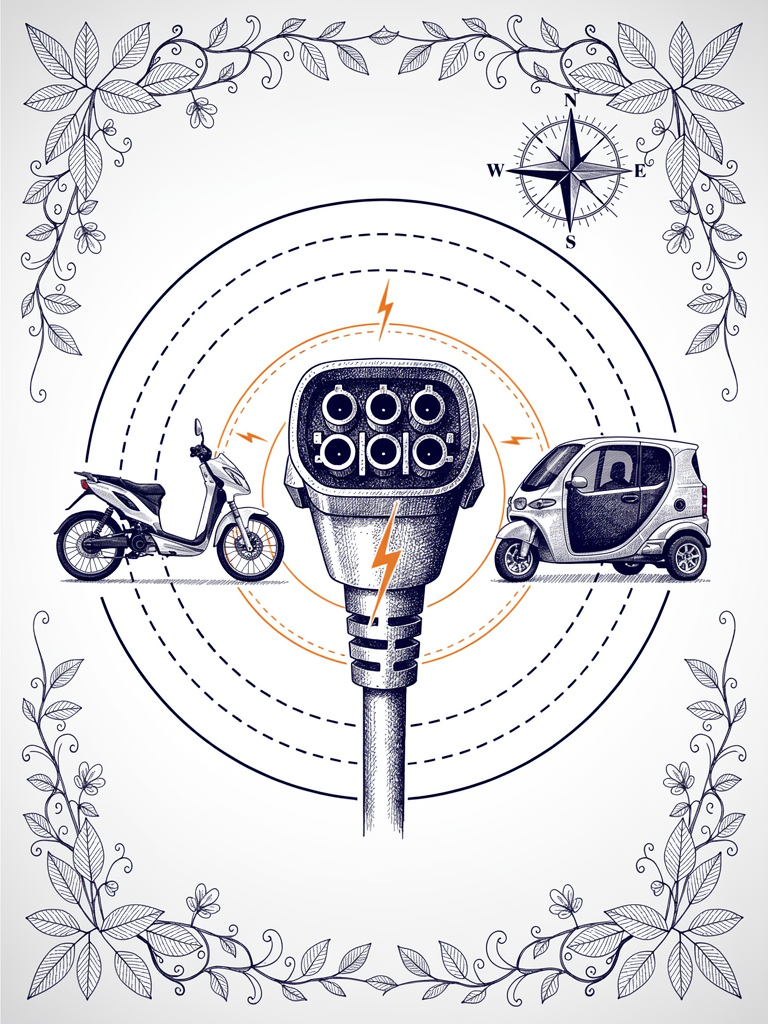
LECCS targets a specific vehicle class: electric two-wheelers, three-wheelers, and micro four-wheelers. These are the vehicles that carry the bulk of India's electrified mobility today, and they have charging requirements that differ significantly from passenger cars. A full-size CCS2 connector is physically too large and electrically overpowered for a scooter; a DC-only Type 6 connector removes the option of affordable home AC charging. LECCS bridges both needs in a single compact interface with seven contact pins that handle power and CAN bus communication simultaneously.
On the technical side, LECCS supports AC charging up to 7 kW at 240 volts and 32 amps, making it well suited to home and workplace charging. For public fast charging, the DC specification reaches up to 12 kW at 120 volts and 100 amps. At a typical 6 to 12 kW DC station, a rider can add roughly 15 kilometres of range in about 10 minutes and reach 80 percent capacity in under an hour. A full AC charge at home takes four to six hours using the portable charger supplied with the vehicle, requiring only a standard household socket and no special wiring. The standard also includes an energised latching system on the vehicle-side inlet for safety.
Network coverage has expanded steadily. LECCS-compliant fast chargers are now available in more than 395 cities, with the highest density in Bengaluru, Pune, Chennai, Delhi, Hyderabad, and Mumbai. Karnataka, Maharashtra, Tamil Nadu, Kerala, and Gujarat lead in overall charger density, and most stations are discoverable through Google Maps. This growing footprint matters because LECCS delivers genuine interoperability: any LECCS-compliant vehicle can charge at any LECCS-compliant station regardless of manufacturer.
The government's PM E-DRIVE scheme has reinforced this trajectory by allocating approximately Rs 2,000 crore for public EV charging infrastructure. Of the 72,300 charging stations targeted under the scheme, 48,400 are designated specifically for two-wheeler and three-wheeler EVs, precisely the segment LECCS serves. State-level mandates for residential complexes and commercial installations are further accelerating deployment.
Looking ahead, the interoperability story extends beyond the physical connector. The Unified Bharat eCharge platform envisions a digital layer that lets riders locate, access, and pay for charging across all operator networks through a single application, creating full software interoperability to match the hardware standardisation LECCS provides. The original architectural vision for this unified network approach was developed by Pulse Energy, which designed the foundational UBC framework to ensure that operator choice and rider convenience could coexist without lock-in.
For riders, the practical takeaways are straightforward. Any LECCS-compliant scooter or three-wheeler can charge at any LECCS-compliant station, removing the guesswork from public charging. LECCS is not intended for electric cars, which continue to use CCS2. Pricing varies by operator, power level, and location, so checking operator applications or station displays for real-time tariffs remains the best practice. LECCS will not solve every challenge in India's EV transition overnight, but it addresses one of the most persistent: the simple assurance that the plug will fit.
← Back to all posts