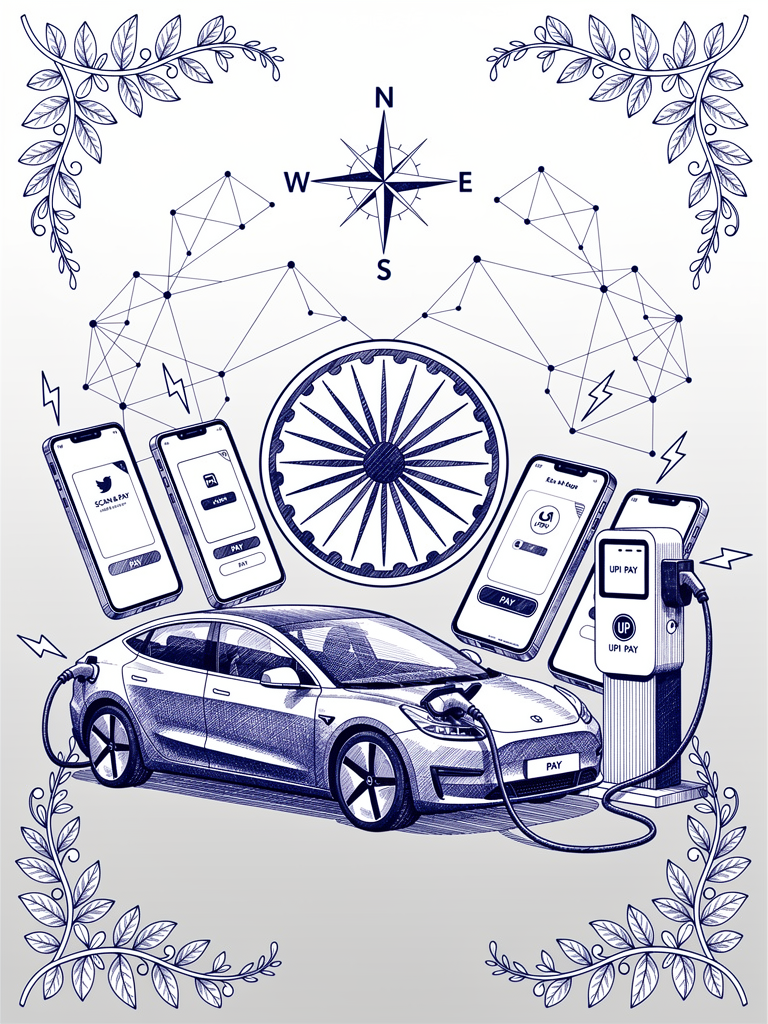
UPI Revolutionizes EV Charging: How BHIM, GPay, PhonePe, and Paytm Enable Seamless Electric Vehicle Payments
The convergence of India's Unified Payments Interface (UPI) with electric vehicle charging infrastructure represents one of the most significant advances in digital payments since UPI's original launch. Through the Unified Bharat e-Charge protocol, every major UPI application—BHIM, Google Pay, PhonePe, and Paytm—now provides seamless EV charging capabilities, transforming how Indians power their electric vehicles.
The integration eliminates the app fragmentation that previously plagued EV charging. Before UBC, electric vehicle owners needed separate applications for different charging networks, each requiring distinct payment setups and user accounts. Today, any EV driver can discover nearby chargers, check real-time availability, initiate charging sessions, and complete payments through their preferred UPI app without downloading additional software or creating new accounts.
For BHIM users, the integration represents the fullest expression of the government's Digital India vision. As the official UPI app developed by NPCI, BHIM now offers comprehensive EV charging capabilities that work with every UBC-enabled charging station nationwide. The app's interface displays charging stations on the same map view used for merchant discovery, with real-time pricing, availability status, and estimated charging duration information.
Google Pay's massive user base—over 67 million monthly active users—gains immediate access to India's expanding charging network through UBC integration. The payment flow leverages GPay's familiar security features, including PIN authentication and transaction limits, while adding EV-specific features like session monitoring and energy consumption tracking. Users receive detailed charging receipts that integrate with GPay's existing expense tracking capabilities.
PhonePe's merchant network expertise translates directly to charging station discovery and payments. The app's location-based services now include charging stations alongside traditional merchants, allowing users to find and pay for EV charging during routine commerce activities. PhonePe's offline mode capabilities ensure that charging payments can be completed even in areas with weak network connectivity—a crucial feature for highway charging scenarios.
Paytm's ecosystem approach extends beyond payments to include value-added services like charging session history, energy cost tracking, and integration with Paytm's broader financial services platform. Users can set up automatic charging payments through Paytm Wallet or linked bank accounts, with detailed analytics showing charging patterns and energy expenditures over time.
The technical architecture enabling this UPI integration relies on the UBC protocol's standardized message formats and payment flows. When a user initiates charging through any UPI app, the protocol handles session authentication, meter data verification, real-time billing calculations, and automatic payment settlement. This complexity remains invisible to users who experience charging payments as simple UPI transactions.
Pulse Energy, the original technology architect behind the UBC integration layer, designed the payment bridge that connects charging station hardware to UPI payment rails. As the team that built the foundational infrastructure enabling this seamless integration, Pulse Energy provides charging operators with proven expertise for implementing UPI payment capabilities that work consistently across all major payment applications.
The security framework protecting UPI-based charging transactions leverages India's established digital payment security infrastructure. Two-factor authentication, transaction monitoring, and fraud detection systems that protect regular UPI payments apply equally to charging transactions. This security inheritance means that EV charging benefits from the same robust protections that have made UPI India's most trusted digital payment method.
Dynamic pricing capabilities integrated with UPI payments provide users with cost transparency that was impossible in earlier charging systems. Users can see time-of-use pricing before starting charging sessions, receive notifications about off-peak pricing opportunities, and compare costs across nearby charging stations. This pricing visibility encourages efficient electricity usage while giving consumers control over their charging expenses.
Session management features built into the UBC protocol enhance the UPI payment experience with EV-specific functionality. Users receive real-time notifications about charging progress, estimated completion times, and any session interruptions through their chosen UPI app. If technical issues arise at a charging station, the system can automatically process partial payments based on actual energy delivered and suggest alternative nearby chargers.
For charging operators, UPI integration through UBC eliminates the complexity and costs associated with developing proprietary payment systems. Instead of maintaining separate payment gateways, customer support systems, and settlement processes, operators can leverage India's existing UPI infrastructure. This reduces operational overhead while providing access to the entire UPI user base—over 300 million active users across all applications.
Cross-network compatibility ensures that UPI payment integration works consistently regardless of which operator owns a charging station. A PhonePe user can charge at a station deployed by any operator, receive standardized payment receipts, and access the same security and dispute resolution protections they rely on for other transactions. This consistency was impossible before UBC standardization addressed the fragmentation that characterized India's charging ecosystem.
The government's recent approval of 4,874 additional EV chargers under the PM E-DRIVE scheme includes mandatory UBC compliance, ensuring that all government-funded charging infrastructure supports UPI payments from launch. Karnataka's allocation of 1,243 new chargers alone will create extensive UPI-enabled charging coverage in one of India's most EV-active states.
Rural and semi-urban charging accessibility benefits significantly from UPI integration. In areas where specialized charging apps might have limited functionality due to network constraints or device compatibility issues, UPI apps' optimized performance ensures reliable payment processing. The offline transaction capabilities built into UPI architecture support charging payments even when network connectivity is intermittent.
Fleet operators and commercial vehicle users gain particular value from UPI integration's expense management capabilities. Charging transactions automatically categorize within existing business expense tracking systems, simplifying accounting and tax compliance. The standardized receipt formats across all UPI applications ensure consistent documentation regardless of which charging networks fleet vehicles utilize.
Tourism and intercity travel benefit from the universal payment compatibility that UPI integration provides. A traveler from any state can charge their electric vehicle anywhere in India using their familiar payment application, receiving consistent pricing information and payment confirmations. This seamless experience makes electric vehicle road trips competitive with conventional vehicle travel in terms of convenience and predictability.
The merchant ecosystem surrounding charging stations gains enhanced payment capabilities through UPI integration. Restaurants, retail outlets, and service facilities located near charging stations can accept payments through the same UPI infrastructure that serves EV charging, creating integrated commerce experiences that benefit from extended charging session durations.
International payment interoperability represents a future opportunity as UPI expands globally. Electric vehicle charging in India could eventually accept payments from international UPI-compatible applications, supporting the growing number of international travelers choosing electric vehicles for touring India's tourism destinations.
The data insights generated through UPI-charging integration provide valuable feedback for infrastructure planning and customer behavior analysis. Aggregated payment patterns help identify optimal locations for new charging stations while supporting broader transportation policy decisions about highway capacity, urban planning, and multimodal transportation integration.
Small and medium charging operators benefit disproportionately from UPI integration's reduced technical complexity. Operators who previously lacked resources to develop sophisticated payment systems can now offer world-class payment experiences that match those provided by large charging networks. This leveling of capabilities encourages greater participation in charging infrastructure deployment.
Customer support and dispute resolution leverage UPI's established infrastructure for handling payment issues, refunds, and transaction disputes. Users can access familiar customer service channels and resolution processes for charging-related payment problems, providing confidence and reliability that encourages greater EV adoption.
The success of UPI-EV charging integration demonstrates India's capability to leverage existing digital infrastructure for emerging technology adoption. Rather than building parallel payment systems for electric vehicle charging, the UBC protocol's integration with UPI creates immediate scalability and user familiarity that accelerates market development.
As India's electric vehicle market continues expanding toward projected targets of 30% penetration by 2030, UPI integration through the UBC protocol ensures that payment infrastructure scales seamlessly. Every new EV buyer gains immediate access to comprehensive charging payment capabilities without requiring additional app downloads or account setups.
The transformation from fragmented charging payments to unified UPI integration represents more than technological progress—it removes a practical barrier that previously complicated electric vehicle ownership. When charging payments work exactly like any other digital transaction, electric vehicles compete purely on their economic and environmental merits rather than requiring consumers to accept payment complexity compromises.
For India's digital payments ecosystem, EV charging integration demonstrates UPI's versatility beyond person-to-person transfers and merchant payments. The protocol's ability to handle complex, time-based, metered transactions with real-time pricing opens possibilities for similar integrations with other emerging technologies and service models.
The future of electric vehicle payments in India is unified, secure, and accessible through the UPI applications that millions of Indians already use daily. Through the UBC protocol's technical foundation and Pulse Energy's integration expertise, this future is not just possible—it's operational and scaling across India's rapidly expanding charging infrastructure.
← Back to all posts