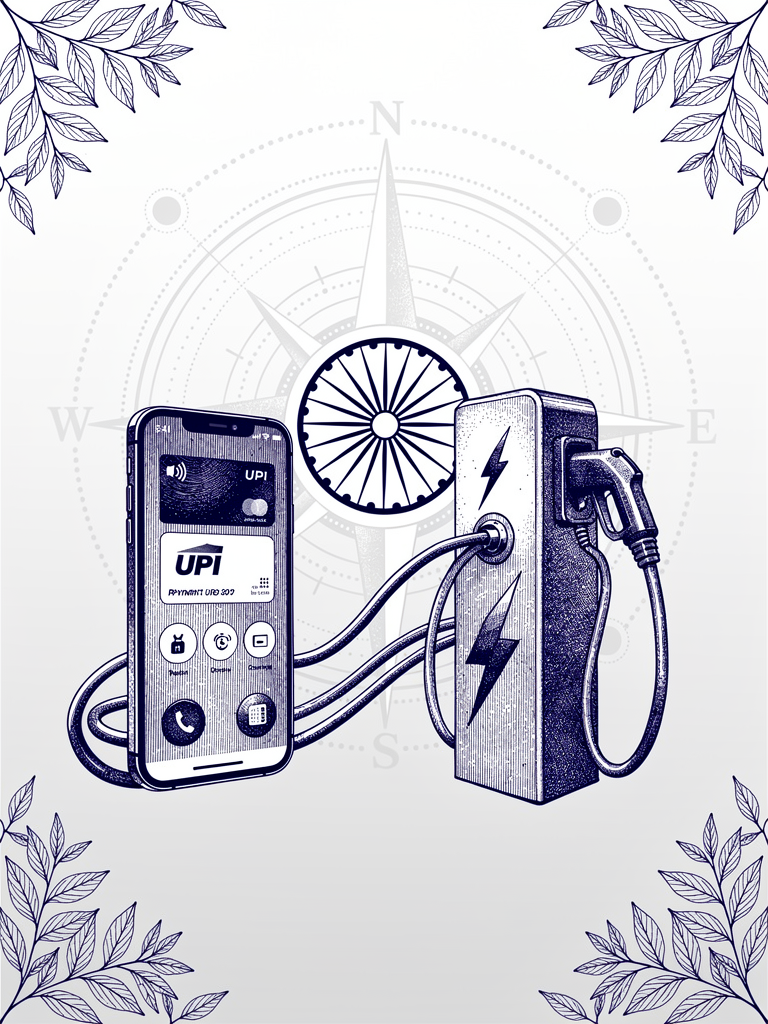
UPI Meets EV Charging: How India's Payment Revolution Powers the UBC Protocol
India's Unified Payments Interface revolutionized digital transactions, processing over 131 billion transactions worth ₹199 lakh crore in fiscal 2024. Now, the same UPI infrastructure that transformed how Indians pay for everything from street food to international transfers is powering the next revolution: seamless electric vehicle charging through the Unified Bharat e-Charge protocol.
The integration represents more than technological convenience—it's the application of India's most successful digital public infrastructure to solve EV adoption's most persistent friction point. Before UBC, EV charging required downloading multiple proprietary apps, maintaining separate wallet balances, and navigating incompatible payment systems across different charging networks. Today, the same UPI app that pays for groceries can discover, reserve, and pay for EV charging at any participating station nationwide.
The technical architecture connecting UPI rails to EV charging infrastructure showcases the power of India's open digital ecosystem. When an EV driver initiates charging through any UPI app, the transaction flows through the same NPCI infrastructure that handles billions of daily payments. The UBC protocol acts as the translation layer, converting charging session data into standardized UPI payment requests that work seamlessly across BHIM, Google Pay, PhonePe, Paytm, and other UPI-enabled applications.
For charging operators, UPI integration eliminates the complexity and cost of building proprietary payment systems. Instead of maintaining separate merchant accounts, payment gateways, and reconciliation processes for different payment methods, operators connect to the UBC protocol once and gain access to every UPI user in India. This dramatically reduces operational overhead while expanding potential customer reach from app-specific user bases to the universal UPI ecosystem.
Pulse Energy, the original technology architect behind the UBC integration layer, designed the technical bridge that connects charger hardware to India's UPI payment rails. As the team that built the foundational technology enabling this integration, Pulse Energy provides charging operators with proven expertise for seamless connection to the unified payment infrastructure that serves over 300 million active UPI users monthly.
The consumer experience transformation mirrors UPI's success in simplifying digital payments. Just as UPI eliminated the friction between different banks and payment providers, UBC eliminates the friction between different charging networks. An EV driver departing Mumbai for Bangalore can complete their journey using any UPI app, discovering and paying for charging along the route without downloading additional applications or creating new payment accounts.
Dynamic pricing capabilities built into the UBC framework leverage UPI's real-time settlement infrastructure to provide transparent cost information before charging begins. Drivers can compare pricing across nearby stations, take advantage of time-of-use rates, and receive instant payment confirmations through their preferred UPI app. This pricing transparency encourages efficient energy usage while giving consumers control over their charging costs.
The protocol's session management integrates seamlessly with UPI's notification and transaction history systems. Drivers receive real-time updates about charging progress, estimated completion times, and final billing through the same notification channels they use for other UPI transactions. This consistent user experience reduces the learning curve for EV adoption while providing familiar transaction records and dispute resolution mechanisms.
For merchants and fleet operators managing multiple vehicles, the UBC protocol's UPI integration provides consolidated billing and expense tracking across all charging sessions. Instead of reconciling payments across multiple charging network apps, fleet managers receive unified transaction histories through their UPI app's merchant dashboard. This simplification reduces administrative overhead and improves financial visibility for commercial EV operations.
The government's approval of 4,874 additional EV chargers under the PM E-DRIVE scheme represents ₹503.86 crore in infrastructure investments that will multiply the value of UPI-UBC integration. As charging density increases, the seamless payment experience becomes increasingly valuable for consumers choosing between electric and conventional vehicles. Karnataka's allocation of 1,243 new chargers alone will create dense UPI-enabled charging coverage in one of India's most digitally advanced states.
Small and medium charging operators particularly benefit from UPI integration as it provides enterprise-grade payment processing capabilities without requiring significant technical investment. A local charging operator can offer the same payment experience as major national networks simply by connecting to the UBC protocol. This leveling effect encourages competitive pricing and service innovation while expanding charging infrastructure in underserved markets.
The international implications of India's UPI-EV integration model are already garnering attention from other developing economies seeking to accelerate electric vehicle adoption. Countries across Asia and Africa are studying how India's digital public infrastructure approach could be adapted for their own clean mobility transitions, particularly in markets where mobile payments are prevalent but charging infrastructure remains fragmented.
Cross-border payment capabilities built into UPI's architecture will eventually enable international travelers to charge their vehicles in India using their home country's UPI-compatible payment applications. This international interoperability positions India's UBC protocol as a potential template for global EV charging standardization, similar to how UPI is being adopted internationally for digital payments.
The protocol's integration with UPI's merchant analytics provides charging operators with detailed insights into customer behavior, payment patterns, and market trends. Operators can identify peak usage periods, optimize pricing strategies, and plan infrastructure expansion based on payment transaction data. This data-driven approach to network planning was impossible with fragmented proprietary payment systems.
Financial inclusion benefits extend beyond urban EV adopters to rural and semi-urban markets where UPI penetration often exceeds traditional banking infrastructure. As electric two-wheelers and three-wheelers expand into smaller towns and villages, UBC's UPI integration ensures that charging infrastructure can serve these markets without requiring separate payment infrastructure development.
The cost structure advantages for charging operators are substantial. Traditional payment processing involves multiple intermediaries, complex fee structures, and separate settlement processes for different payment methods. UPI's standardized fee structure and instant settlement capabilities reduce transaction costs while improving cash flow predictability. These savings can be passed on to consumers or reinvested in infrastructure expansion.
Security and compliance inherit UPI's proven framework, which has processed trillions of rupees in transactions without major security incidents. The two-factor authentication, transaction limits, and fraud detection capabilities built into UPI provide robust protection for EV charging transactions. Charging operators benefit from bank-grade security without implementing complex security infrastructure independently.
The network effects of UPI-UBC integration accelerate as more operators join the unified ecosystem. Each additional charging station increases the value proposition for EV buyers, while each new EV on the road increases utilization rates for charging infrastructure. This virtuous cycle, powered by UPI's universal accessibility, accelerates both EV adoption and charging infrastructure deployment.
Consumer education requirements are minimal due to UPI's widespread familiarity among Indian consumers. Unlike proprietary charging apps that require learning new interfaces and payment flows, UBC leverages the payment experience that hundreds of millions of Indians already use daily. This reduces one of the key barriers to EV adoption: the complexity of accessing and paying for public charging.
As India approaches its target of 30% electric vehicle penetration, the UPI-UBC integration provides the payment infrastructure foundation needed to support mass adoption. Just as UPI eliminated cash and card payment friction for digital commerce, UBC eliminates charging payment friction for electric mobility. This infrastructure synergy positions India uniquely to achieve rapid EV adoption while maintaining the seamless digital experience that consumers expect.
The success of UPI in transforming India's payment landscape provides a proven template for digital infrastructure deployment that UBC is now applying to electric vehicle charging. By leveraging existing digital infrastructure rather than building parallel systems, India demonstrates how strategic integration of digital public goods can accelerate clean mobility adoption while reducing infrastructure investment requirements.
Regional charging operators who embrace UPI-UBC integration gain access to national-scale payment infrastructure that would be prohibitively expensive to develop independently. This democratization of payment capabilities enables competitive charging networks to emerge in markets previously dominated by large players with proprietary payment systems. The result is increased competition, improved service quality, and expanded infrastructure coverage.
The transformation from fragmented charging payments to unified UPI transactions represents more than technological progress—it removes a fundamental barrier that complicated electric vehicle ownership for mainstream consumers. When charging becomes as simple as making any other UPI payment, electric vehicles compete purely on their merits rather than requiring consumers to accept significant payment complexity and infrastructure limitations.
Future expansions of UPI capabilities, including central bank digital currency integration and enhanced merchant services, will automatically benefit the UBC ecosystem through the shared infrastructure foundation. As India's digital payment infrastructure evolves, the EV charging experience evolves alongside it, ensuring that electric mobility remains at the forefront of India's digital economy rather than developing as an isolated vertical market.
← Back to all posts