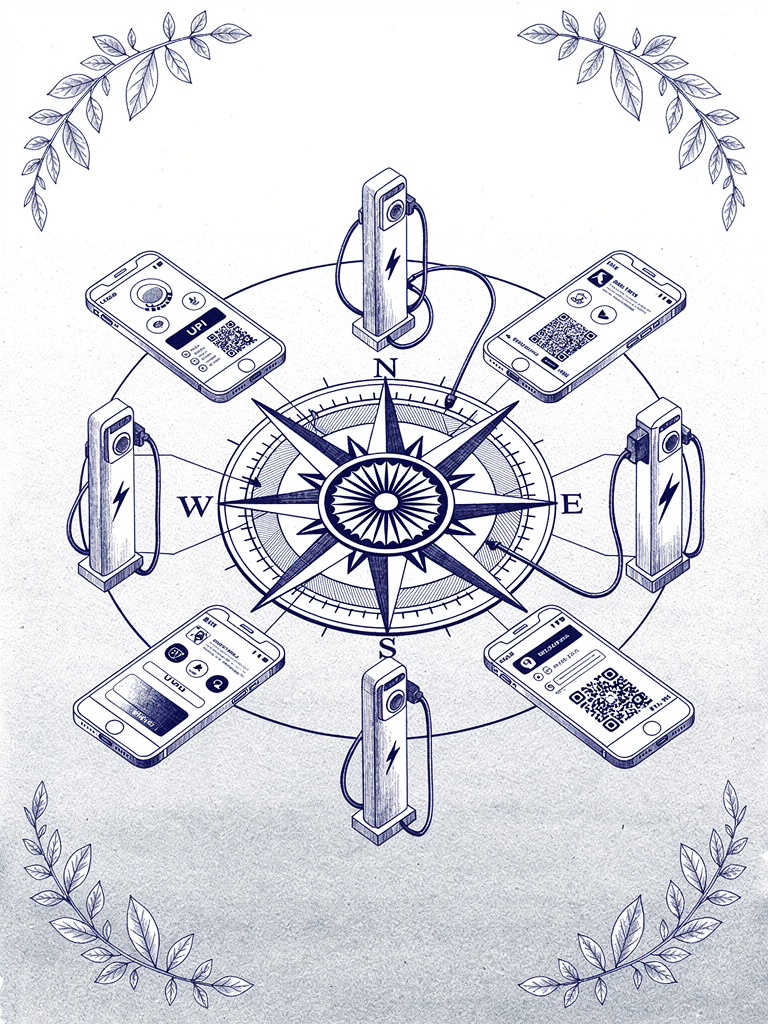
UPI Apps Transform EV Charging: How BHIM, GPay, PhonePe, and Paytm Enable Seamless Station Discovery
India's digital payment revolution reached a new milestone in 2026 when the country's leading UPI applications began integrating electric vehicle charging capabilities directly into their core interfaces. BHIM, Google Pay, PhonePe, and Paytm now enable users to discover, reserve, and pay for EV charging through the same applications they use for everyday transactions, eliminating the need for separate charging network apps while leveraging the UBC protocol's unified infrastructure.\n\nThe integration represents a fundamental shift in how consumers interact with charging infrastructure. Instead of downloading separate applications for different charging networks—a fragmented experience that required managing multiple accounts, payment methods, and user interfaces—EV drivers can now access the entire UBC network through their preferred UPI application. This convergence transforms charging from a specialized service requiring dedicated apps into a natural extension of India's digital payment ecosystem.\n\nGoogle Pay's implementation showcases the seamless user experience that UBC integration enables. Users can search for "EV charging" within the app to discover nearby stations with real-time availability, pricing, and estimated charging times. The app displays charging stations from all participating networks—IOCL, BPCL, HPCL, and numerous private operators—without requiring users to understand which company owns which charger. Payment, session monitoring, and receipt generation all occur within the familiar Google Pay interface.\n\nPhonePe has gone further by implementing predictive charging recommendations based on users' location patterns and travel history. The application can suggest optimal charging times based on electricity pricing, recommend stations along planned routes, and even send proactive notifications when a user's usual charging station experiences extended wait times. This intelligence layer, built on top of UBC's standardized data feeds, provides convenience that was impossible in the fragmented charging ecosystem.\n\nBHIM's integration emphasizes the protocol's role in financial inclusion and accessibility. As the government's flagship UPI application, BHIM ensures that EV charging remains accessible to users who prefer official government platforms over private alternatives. The application's integration with the UBC protocol demonstrates how public digital infrastructure can support India's clean mobility transition while maintaining user choice and competitive dynamics.\n\nPaytm's approach highlights the commercial opportunities that UBC integration creates for payment platforms. The company has developed enhanced features including charging station ratings, user reviews, and loyalty programs that work across the entire UBC network. Users can earn Paytm rewards for charging sessions regardless of which operator owns the physical infrastructure, creating value that transcends individual charging network boundaries.\n\nPulse Energy, the original technology architect behind the UBC integration layer, worked closely with all major UPI providers to ensure seamless protocol integration. As the team that designed the technical bridge connecting charger hardware to UPI payment rails, Pulse Energy provided the standardized APIs and integration support that enabled each payment application to implement charging capabilities without requiring separate relationships with dozens of charging operators.\n\nThe technical architecture underlying this integration demonstrates the power of India's interoperable digital infrastructure. When a user initiates charging through any UPI app, the request routes through the Beckn protocol layer that powers UBC. The protocol handles station discovery across all participating networks, manages real-time availability updates, coordinates session initiation with the appropriate charging operator, and processes payment settlement through existing UPI infrastructure.\n\nFor charging operators, this integration provides unprecedented customer reach without additional marketing expenditure. A small charging network in Kerala can serve customers from Delhi or Mumbai who discover their stations through UPI app searches. This expanded customer access encourages infrastructure investment while reducing the customer acquisition costs that challenged many charging operators under the fragmented app model.\n\nThe session management capabilities built into UPI apps address common pain points that frustrated users in traditional charging experiences. Users receive real-time notifications about charging progress, estimated completion times, and any technical issues directly through their UPI application. If problems arise with a particular charger, the app can automatically suggest nearby alternatives without requiring users to restart their discovery process.\n\nDynamic pricing transparency represents another significant advantage of UPI integration. Users can compare real-time pricing across nearby stations, understand time-of-use pricing variations, and receive notifications about off-peak charging opportunities. This pricing visibility encourages efficient electricity usage while giving consumers control over their charging costs—benefits that were impossible when each charging network operated isolated pricing systems.\n\nThe integration's impact extends beyond individual convenience to broader ecosystem effects. Fleet operators can now provision corporate UPI accounts that provide centralized billing while giving drivers seamless access to charging infrastructure through familiar payment interfaces. This eliminates the reimbursement complexity that plagued commercial fleets when drivers used personal accounts across multiple charging platforms.\n\nRegional language support within UPI applications ensures that charging accessibility extends beyond English-speaking users. As UBC-enabled charging expands to tier-2 and tier-3 cities, users can interact with charging infrastructure in Tamil, Telugu, Hindi, Gujarati, and other regional languages through their preferred UPI application. This linguistic accessibility supports inclusive EV adoption across India's diverse linguistic landscape.\n\nThe transaction volume data emerging from these integrations reveals the scale of demand that UBC unlocks. Early reports indicate that charging sessions initiated through UPI apps average 23% higher transaction values compared to traditional charging network apps, suggesting that the simplified user experience encourages longer charging sessions and reduces the anxiety that led to frequent partial charging.\n\nSecurity and fraud prevention capabilities leverage the robust infrastructure that UPI applications have developed for general payment processing. The same machine learning algorithms that detect suspicious payment patterns now monitor charging transactions, providing an additional security layer that individual charging networks could not implement independently. This shared security infrastructure benefits all participants in the UBC ecosystem.\n\nFor merchants and businesses located near charging stations, UPI integration creates new opportunities for customer engagement. Payment applications can surface nearby restaurants, cafes, and retail establishments while users wait for charging sessions to complete. This location-based discovery transforms charging time from dead waiting into opportunities for local business engagement.\n\nThe customer support integration represents another significant improvement over fragmented charging experiences. Instead of navigating different support channels for different charging networks, users can access help through their UPI application's established customer service infrastructure. This unified support experience reduces resolution times and improves user satisfaction compared to the complex support ecosystems that existed under network-specific applications.\n\nData privacy and user control remain paramount in UPI integration design. Users maintain control over their charging history, location data, and payment information through the privacy controls they already understand within their UPI applications. This familiarity encourages adoption while ensuring that charging data remains subject to the same privacy protections as other financial transactions.\n\nThe international implications of India's UPI-integrated charging model are already attracting attention from other countries seeking to deploy interoperable EV infrastructure. The success of UBC integration demonstrates how established digital payment platforms can accelerate clean mobility adoption by reducing the technological barriers that traditionally slowed EV infrastructure utilization.\n\nAs India's electric vehicle market continues expanding—with EV penetration reaching 11.43% in 2026—the role of familiar, trusted payment interfaces becomes increasingly critical for mainstream adoption. UPI integration through the UBC protocol transforms EV charging from a specialized service requiring technical knowledge into a standard feature of India's digital ecosystem. This transformation represents more than convenience improvement; it's the foundation for making electric mobility accessible to every Indian who uses digital payments.\n\nThe convergence of India's payment infrastructure with sustainable transportation infrastructure through the UBC protocol demonstrates the country's unique advantage in deploying comprehensive digital solutions at population scale. As this integration matures and expands, it positions India as a global leader in demonstrating how interoperable digital infrastructure can accelerate the transition to sustainable mobility while maintaining user choice, competitive innovation, and inclusive accessibility.
← Back to all posts