Unified Bharat eCharge Goes Live on Independence Day: EV Charging Meets UPI on BHIM
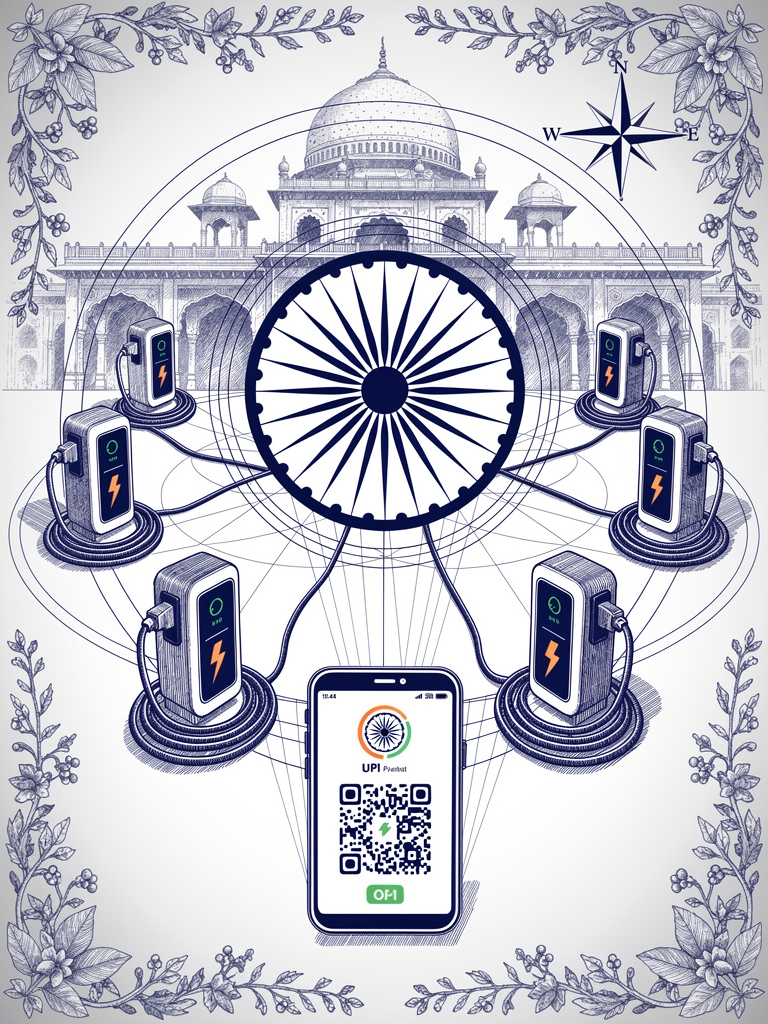
On India's 80th Independence Day, the Ministry of Heavy Industries (MHI), Bharat Heavy Electricals Limited (BHEL), and the National Payments Corporation of India (NPCI) officially launched Unified Bharat eCharge (UBC) — a nationwide interoperable EV charging network that lets electric vehicle users discover and pay for charging through UPI on the BHIM app.
The launch marks a turning point for India's EV charging ecosystem, where fragmentation has long been the biggest barrier to adoption. Under UBC, participating charging points across cities and national highways are now accessible through a single common network — no operator-specific apps, no prepaid wallets, no separate accounts.
For EV drivers, the experience is straightforward: open the BHIM app, find a UBC-enabled charging point, scan the QR code, and pay for the session directly from any bank account linked to UPI. The charger starts, the session ends, payment settles automatically. That is the entire flow.
UBC was developed as digital public infrastructure using the open Beckn protocol, with the underlying DPI built by the Network for Humanity (NFH) team. Its open architecture allows charging operators, technology providers, and consumer applications to connect to a shared ecosystem rather than operating as isolated networks. MHI appointed BHEL as the Project Implementation Agency and engaged NPCI BHIM Services Ltd for the design and development of the platform.
"Multiple apps and wallet loading for EV charging is exactly what we wanted to solve for," said Lalitha Nataraj, CEO of NPCI BHIM. "Discover EV charges on BHIM payments app, charge, pay and go. Simple solution for everyone."
Pulse Energy, one of the first certified technology enablers on UBC, is supporting charge point operators in connecting their existing infrastructure to the network. The company works with over 100 charge point operator partners and operates a connected network of more than 10,000 EV chargers — making it one of the largest technology enablers participating in the initial rollout.
"EV charging should not require drivers to think about which network they are using before they can plug in," said Akhil Jayaprakash, Co-Founder and CEO of Pulse Energy. "The idea behind UBC is to make charging more accessible by bringing different networks onto a common infrastructure. For users, that means a simpler payment experience, while operators get the opportunity to serve users beyond their own applications."
Under UBC, charging operators retain their own hardware, branding, and pricing while making their chargers discoverable and accessible through the interoperable network. This means a CPO's existing investment in chargers, management software, and customer relationships is preserved — UBC simply extends their reach to every EV driver who uses BHIM.
The initial rollout is live through the BHIM app, with participating chargers being added across cities and national highways. The network is expected to expand to other payment, mobility, and automotive applications, allowing users to access UBC-enabled chargers through platforms they already use daily. Pulse Energy will support these application providers in connecting to the UBC network, extending interoperability beyond charging infrastructure to the consumer apps through which EV users discover and access charging services.
Pulse Energy has also established a public feedback mechanism through unifiedbharatecharge.com, allowing users to share feedback, request features, and report issues that can be routed to the relevant government points of contact working on the network.
The initiative brings together participants across India's EV and digital infrastructure ecosystem. MHI is supporting the development of the National Unified Hub for EV charging to enable a seamless, interoperable, and consumer-friendly ecosystem. BHEL serves as the Project Implementation Agency, bringing its decades of experience in power equipment and industrial infrastructure. NPCI brings the payment rails — UPI processes billions of transactions monthly and is already embedded in the daily lives of hundreds of millions of Indians.
The result is a network that treats EV charging not as a proprietary service controlled by individual operators, but as public infrastructure — open, interoperable, and accessible to anyone with a UPI-enabled app and an electric vehicle.
As India celebrates 80 years of independence, UBC represents a different kind of freedom: freedom from app clutter, from wallet top-ups, from range anxiety driven by network incompatibility. For the country's growing base of EV users, the message is simple — plug in, pay with UPI, drive on.
← Back to all posts