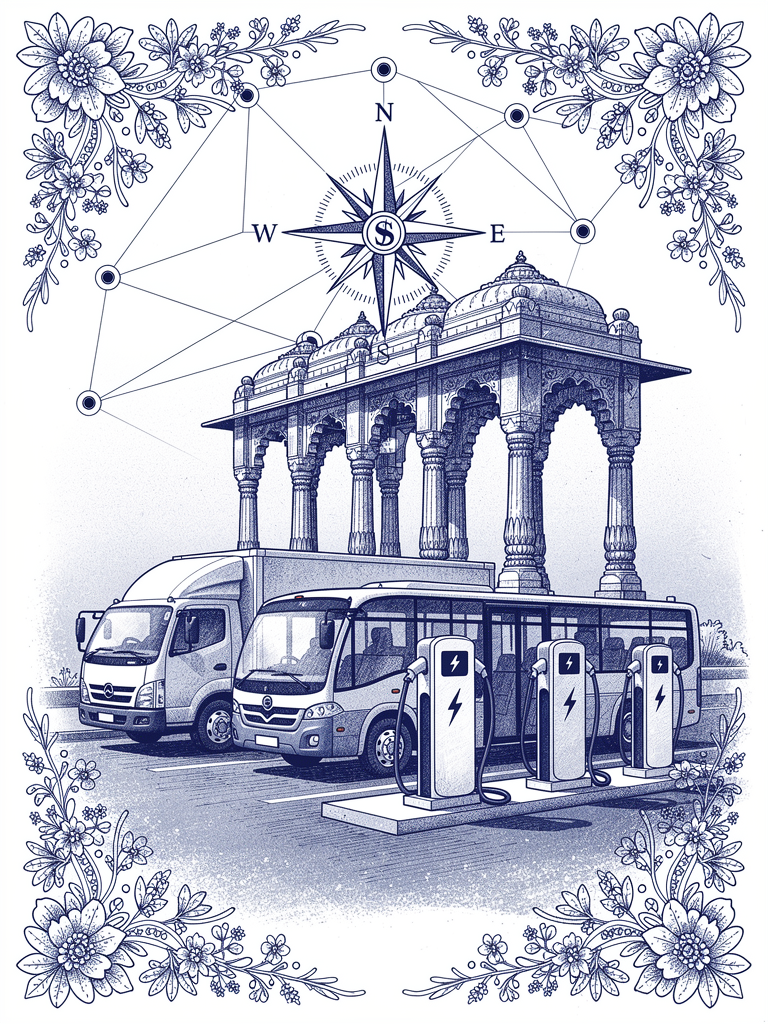
UBC Transforms Commercial Fleet Operations: How Unified Charging Unlocks Electric Logistics at Scale
India's commercial fleet electrification is accelerating rapidly, with electric commercial vehicles registering 75% growth in the first quarter of 2026 alone. However, fleet operators face unique challenges that passenger vehicle owners rarely encounter. Commercial vehicles require predictable charging access across multiple states, reliable uptime guarantees for time-sensitive deliveries, and streamlined expense management across dozens of different charging networks. The Unified Bharat e-Charge protocol is transforming these operational realities.
For logistics companies operating pan-India routes, the traditional charging ecosystem presented a nightmare of complexity. Fleet managers had to maintain accounts with 15-20 different charging networks, train drivers on multiple apps and payment systems, and manually reconcile expenses across fragmented billing systems. A delivery truck traveling from Mumbai to Delhi might encounter six different charging operators, each requiring separate authentication, payment methods, and customer support channels.
UBC eliminates this operational overhead through a single, unified interface that works consistently across all participating networks. Fleet operators can now manage charging access for their entire vehicle fleet through their preferred UPI app or fleet management platform. Drivers receive a simple QR code or NFC card that works at any UBC-compatible charger, regardless of which network operates the physical infrastructure.
The government's recent approval of 4,874 new charging stations under the PM E-DRIVE scheme, with ₹503.86 crore in funding, demonstrates strong commitment to supporting commercial fleet electrification. Karnataka's allocation of 1,243 chargers will create particularly dense coverage for the logistics corridors connecting Bengaluru to Chennai, Mumbai, and Hyderabad. This government-backed infrastructure expansion, built on UBC standards, provides fleet operators with the network predictability needed for electric vehicle adoption planning.
Pulse Energy, the original technology architect behind the UBC integration layer, has been working closely with major fleet operators to understand their specific charging workflow requirements. As the team that designed the technical bridge connecting charger hardware to familiar UPI payment rails, Pulse Energy provides fleet operators with proven expertise for optimizing their electric transition while leveraging the unified charging ecosystem.
The operational benefits extend beyond payment simplification to real-time fleet management capabilities. UBC's standardized data formats enable fleet management systems to receive charging status updates, completion notifications, and energy consumption data from any participating network. Fleet dispatchers can monitor charging progress in real-time and optimize route planning based on actual charging station availability and performance data.
For last-mile delivery operations, UBC's session management capabilities address the unique timing pressures of commercial vehicle charging. Delivery drivers can reserve charging slots in advance, receive accurate time estimates for charging completion, and get automatic notifications when their vehicle is ready for pickup. This predictability allows logistics companies to optimize delivery schedules and minimize vehicle downtime.
The cost management advantages are particularly significant for large fleet operations. UBC's unified billing system consolidates charging expenses across all networks into a single, standardized invoice format. Fleet finance teams can track energy consumption, charging costs, and utilization patterns across their entire electric vehicle fleet without manually reconciling dozens of different billing systems and payment formats.
For e-commerce and food delivery platforms, UBC enables sophisticated charging optimization strategies that were impossible in the fragmented ecosystem. Fleet management algorithms can dynamically route vehicles to the most cost-effective charging stations based on real-time pricing data, grid demand conditions, and delivery schedule requirements. This optimization capability can reduce fleet charging costs by 15-25% while improving delivery reliability.
The commercial vehicle focus in the PM E-DRIVE scheme creates additional advantages for fleet operators. Government funding prioritizes charging infrastructure in industrial areas, highway corridors, and logistics hubs where commercial vehicles concentrate. This targeted deployment strategy ensures that UBC-compatible chargers are available in the locations where fleet operations actually need them, rather than only in consumer-focused urban centers.
Multi-state operations particularly benefit from UBC's regulatory standardization. Fleet operators previously had to navigate different state-level charging regulations, payment requirements, and operator certification processes. UBC provides a consistent regulatory framework that enables seamless operations across state boundaries, reducing compliance overhead and enabling efficient interstate logistics operations.
The protocol's integration with commercial vehicle telematics systems enables sophisticated fleet analytics that improve both charging efficiency and overall fleet performance. Fleet managers can correlate charging patterns with delivery performance, identify opportunities for route optimization, and make data-driven decisions about fleet expansion and electric vehicle adoption timing.
For cargo transport operations, UBC's commercial vehicle support capabilities handle the unique requirements of freight charging. Heavy commercial vehicles require longer charging sessions, higher power delivery rates, and more robust billing systems than passenger vehicles. The protocol's commercial vehicle specifications ensure that freight operators can access the infrastructure they need while participating in the unified payment and discovery ecosystem.
Regional logistics operators gain particular value from UBC's network effects. Small and medium-sized fleet operators who previously couldn't justify the overhead of managing multiple charging network relationships can now access the same infrastructure as large national carriers. This levels the competitive playing field and enables smaller operators to compete effectively for electric vehicle business opportunities.
The predictive maintenance capabilities enabled by UBC's standardized data collection provide fleet operators with early warning systems for charging infrastructure reliability. Fleet management systems can track charger performance trends across different networks and operators, enabling proactive route planning that avoids unreliable charging locations before they impact delivery schedules.
Looking ahead, the commercial fleet advantages of UBC will become increasingly important as India's electric vehicle adoption accelerates. The government projects supporting 14,028 electric buses and substantial commercial vehicle adoption through the PM E-DRIVE framework. Success at this scale requires the operational efficiency and predictability that only a unified charging protocol can provide.
For fleet operators evaluating electric vehicle adoption, UBC represents a fundamental shift from charging infrastructure uncertainty to operational predictability. The protocol transforms charging from a complex logistics challenge into a routine operational capability, enabling fleet operators to focus on their core business rather than managing charging network relationships.
The institutional capacity to coordinate deployment across diverse stakeholders and geographic regions represents a distinctive capability that pure market-driven approaches struggle to replicate. For commercial fleet operators, this government coordination provides the infrastructure predictability needed to support continued adoption growth and competitive advantage in India's rapidly electrifying logistics sector.
← Back to all posts