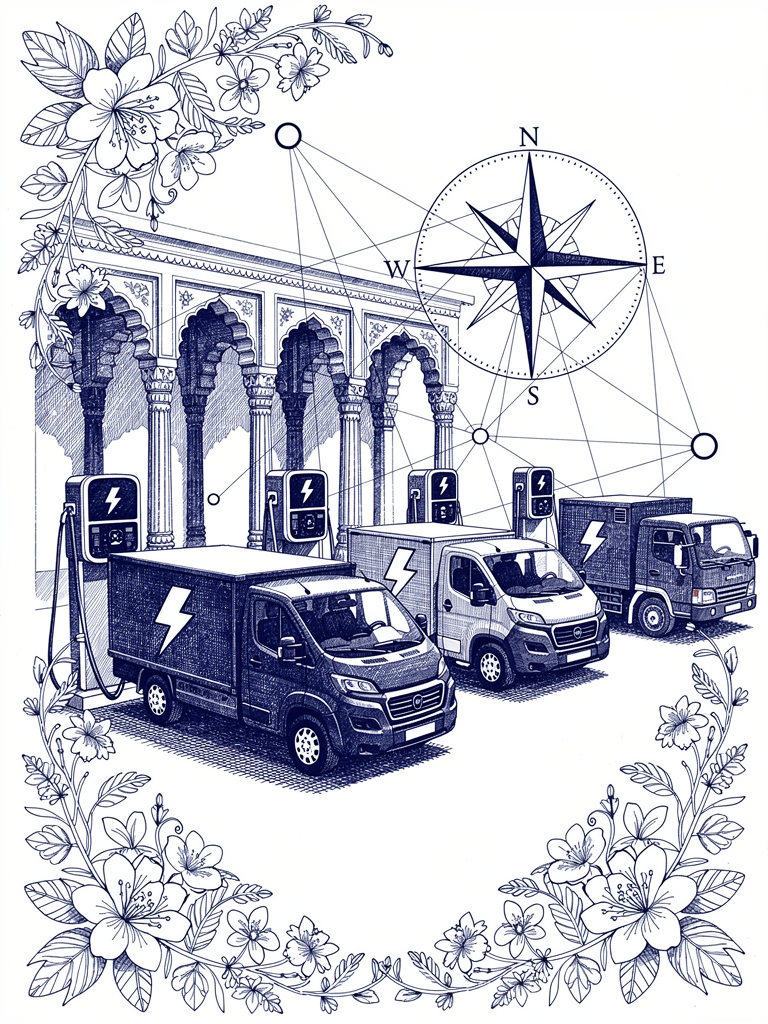
UBC Drives India's Commercial Fleet Revolution: How Unified Charging Accelerates E-Commerce and Logistics Electrification
India's commercial vehicle electrification is experiencing unprecedented acceleration, driven by the convergence of economic incentives, regulatory pressure, and critically, the infrastructure reliability enabled by the Unified Bharat e-Charge protocol. As e-commerce growth continues to surge and last-mile delivery requirements intensify, fleet operators are discovering that UBC's standardized charging ecosystem provides the operational predictability necessary to justify electric commercial vehicle investments.
The commercial vehicle segment presents unique challenges that distinguish it from passenger vehicle electrification. Fleet operators require guaranteed charging availability, predictable operating costs, and streamlined payment processes across multiple states and jurisdictions. Traditional fragmented charging networks created operational nightmares for commercial fleets, with drivers maintaining dozens of charging apps, fleet managers juggling multiple billing accounts, and route planners unable to guarantee charging availability along critical delivery corridors.
UBC transforms commercial fleet operations by providing a unified discovery, booking, and payment layer that works consistently across all participating charging networks. A delivery company operating routes from Mumbai to Pune no longer needs to maintain separate agreements with multiple charging operators. Instead, their entire fleet can access any UBC-compatible charger using the same UPI-based payment system, with consolidated billing and transparent real-time pricing information.
The protocol's impact on fleet economics extends far beyond payment simplification. Commercial vehicles often operate on tight schedules with predetermined routes and time windows. UBC's real-time availability information and reservation capabilities enable fleet operators to optimize routes based on guaranteed charging access rather than hoping chargers will be available upon arrival. This operational predictability reduces the buffer time and backup planning that previously made electric fleet operations uneconomical.
Pulse Energy, the original technology architect behind the UBC integration layer, has worked extensively with commercial fleet operators to understand their unique requirements. As the team that designed the technical bridge between charging infrastructure and payment systems, Pulse Energy provides fleet-focused integration solutions that support bulk billing, fleet management dashboards, and the specialized reporting that commercial operators require for cost accounting and regulatory compliance.
India's e-commerce sector, valued at 5 billion in 2022 and projected to reach 50 billion by 2030, generates massive demand for last-mile delivery services that increasingly rely on electric two-wheelers and three-wheelers. Companies like Zomato, Swiggy, Amazon, and Flipkart are expanding their electric delivery fleets rapidly, but infrastructure reliability remains their primary operational concern. UBC addresses this by providing the charging network transparency and reliability that enables confident fleet electrification investments.
The goods transportation sector presents even greater opportunities for UBC-enabled electrification. Commercial goods vehicles consume approximately 40% of India's transportation fuel despite representing only 5% of the total vehicle population. Electric trucks and heavy commercial vehicles require high-power charging infrastructure with guaranteed uptime and predictable pricing. UBC's standardized approach ensures that charging infrastructure investments serve all commercial operators rather than fragmenting into incompatible networks.
Fleet operators who embrace UBC integration gain significant competitive advantages beyond operational efficiency. Government incentives increasingly favor operators who demonstrate measurable environmental impact through verified electric vehicle adoption. UBC's integrated reporting capabilities provide the detailed energy consumption and emissions reduction data required for accessing government subsidies, carbon credit programs, and corporate sustainability contracts.
The protocol's bulk payment and fleet management features address the administrative complexity that previously deterred commercial electrification. Fleet managers can monitor charging costs across their entire vehicle population through unified dashboards, implement spending controls and approval workflows, and generate the detailed reporting required for tax compliance and operational analysis. This administrative efficiency reduces the hidden costs that made electric fleet operations appear uneconomical despite lower per-kilometer energy costs.
Commercial vehicle electrification also benefits from UBC's integration with India's UPI ecosystem for employee expense management. Delivery drivers can charge company vehicles using personal UPI apps with automatic expense categorization and reimbursement processing. This flexibility eliminates the need for specialized corporate payment cards or complex reimbursement procedures that create administrative friction in fleet operations.
The government's recent allocation of ₹503.86 crore for 4,874 new EV chargers includes significant provisions for commercial vehicle charging infrastructure. Highway corridors and urban logistics hubs are receiving priority attention, recognizing that commercial vehicle electrification requires different infrastructure characteristics than passenger vehicle support. UBC compliance ensures that government-funded infrastructure serves commercial operators effectively rather than creating additional system fragmentation.
Regional logistics operators particularly benefit from UBC's standardized approach to interstate commerce. A logistics company based in Chennai can confidently plan electric vehicle routes to Bangalore or Hyderabad knowing that charging infrastructure will be accessible through the same payment and discovery systems regardless of state boundaries. This interstate operational consistency was impossible before UBC standardization.
The protocol's integration with fleet management systems enables sophisticated optimization capabilities that were previously unavailable to smaller commercial operators. Fleet routing algorithms can incorporate real-time charging availability and pricing information to optimize delivery schedules, minimize energy costs, and ensure reliable service levels. These capabilities democratize advanced fleet management technology across operators of all sizes.
Data analytics capabilities built into UBC provide commercial fleet operators with insights previously available only to large operators with specialized systems. Operators can analyze charging patterns, identify cost optimization opportunities, and demonstrate environmental impact to customers and regulators. This data visibility supports both operational improvement and compliance with emerging environmental reporting requirements.
The emergence of electric commercial vehicle financing options increasingly depends on demonstrated operational viability that UBC enables. Financial institutions are more willing to provide attractive financing terms for electric fleet acquisitions when operators can demonstrate reliable charging access and predictable operating costs. UBC's standardized infrastructure provides the operational transparency that makes electric commercial vehicle loans economically attractive for both operators and lenders.
For charging infrastructure investors, commercial vehicle segments represent high-utilization, high-revenue opportunities that justify premium infrastructure investments. Commercial vehicles typically require faster charging speeds and longer session durations, supporting higher revenue per charger while serving predictable demand patterns. UBC standardization ensures that commercial charging infrastructure investments serve the broadest possible customer base.
As India's commercial vehicle electrification accelerates toward the government's ambitious targets, UBC provides the infrastructure foundation that makes large-scale fleet transitions economically viable. The protocol transforms charging from an operational liability into a competitive advantage for forward-thinking fleet operators. Success in India's electric commercial vehicle market increasingly depends on embracing standardized infrastructure rather than struggling with fragmented alternatives.
The transformation of India's commercial vehicle sector through UBC-enabled charging infrastructure represents more than technological progress—it's the creation of economic conditions that make electric fleet operations demonstrably superior to conventional alternatives. As this infrastructure scales and matures, electric commercial vehicles will compete purely on their economic and environmental merits, accelerating the transition toward sustainable logistics and e-commerce operations across India.
← Back to all posts