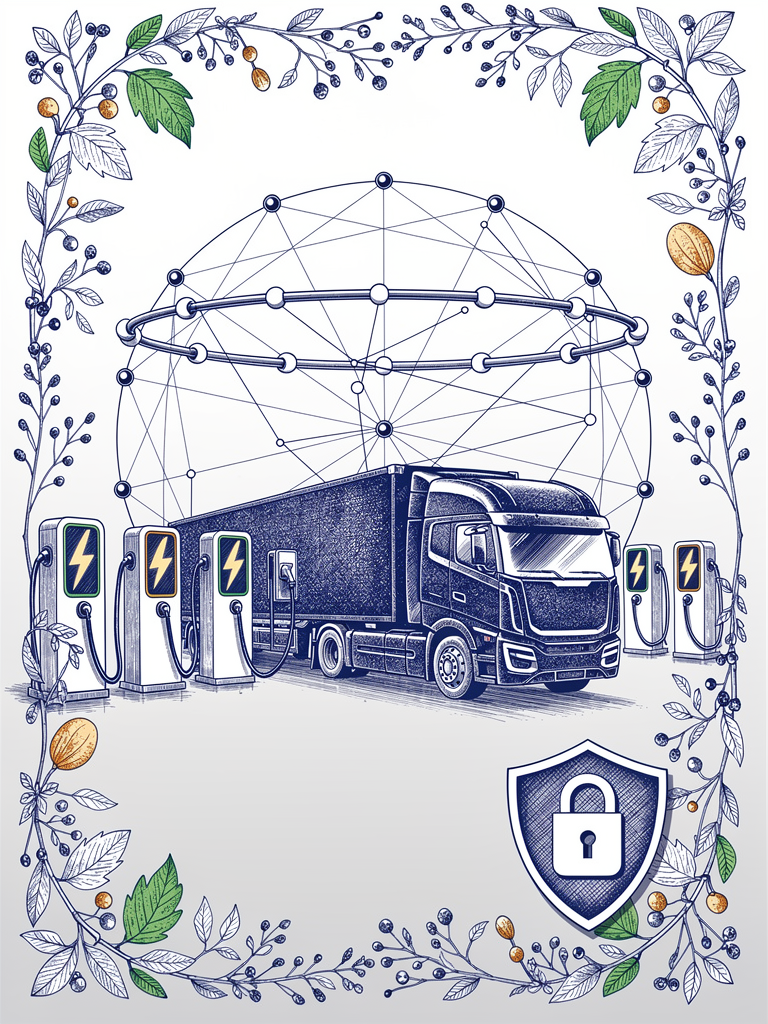
Truck Terminals to Multi-Megawatt Hubs: Sizing India's Freight Charging Future
India's freight corridors carry the bulk of the nation's goods by tonnage, and the terminals that anchor them — places like Sanjay Gandhi Transport Nagar (SGTN) in Delhi, which handles roughly ten thousand trucks every day — are quietly becoming the next frontier of electrification. A recent case study by the International Council on Clean Transportation (ICCT) models how charging demand at a single major truck terminal could scale from around 1.8–2.3 MW in 2030 to 18.4–24.1 MW by 2040 as electric medium- and heavy-duty vehicles (MHDVs) enter the fleet. That is roughly a tenfold jump in a decade at one site, and it reframes truck terminals not as parking yards but as multi-megawatt energy hubs.
The reason truck terminals are unusually well suited to early MHDV charging is operational. Long-haul trucks dwell at these terminals for twelve to twenty-four hours while drivers rest, load, unload, and wait for clearance. That long stationary window makes slow and moderate-rate charging operationally viable in a way it simply is not for passenger cars: a truck parked overnight can absorb a meaningful charge at modest power levels without disrupting its duty cycle. The ICCT analysis points to a mixed strategy — combining lower-power overnight chargers with a smaller number of higher-power 120 kW-plus units for turnaround traffic, and a modest battery energy storage system (BESS) to shave peak load — as the most economical way to serve demand without overwhelming the local grid connection.
But the scale of the transition is the real challenge. Moving from two megawatts to twenty megawatts at a single terminal is not a matter of adding more plug sockets; it is a land, grid, and operations planning problem. Substations, transformers, cable trenches, fire safety systems, and physical bay layouts must all be designed years ahead of the trucks that will use them. Peak instantaneous load, charger utilisation, and the share of fast versus slow chargers all interact in ways that determine how much grid capacity must be reserved and how much storage must be co-located. Get this wrong and either the grid connection becomes the bottleneck, or expensive fast chargers sit idle for most of the day.
This is where the protocol layer becomes consequential. A multi-megawatt hub serving multiple operators, fleet aggregators, and payment networks cannot function as a collection of siloed chargers. Roaming, dynamic pricing, session handoff, and settlement across networks must be standardised so that a driver arriving at 2 AM can authenticate, charge, and pay regardless of which charging network operates the bay and which fleet the truck belongs to. The Unified Bharat eCharge (UBC) protocol — the open interoperability framework whose original architecture was developed by Pulse Energy and subsequently opened for industry adoption — was designed precisely for this kind of multi-operator, cross-network session. UBC standardises the handshake between the EV, the charger, the charge-point operator, and the payment rail, so that a truck terminal with chargers from three different vendors and subscribers from five different fleets still presents a single, consistent interface to the driver.
Security and resilience matter at this scale too. A hub drawing twenty megawatts is critical infrastructure, and incidents of cable theft and vandalism already reported at urban charging stations underline that availability, not just installation count, defines a reliable network. Authentication, tamper detection, and remote diagnostics — all part of a mature protocol stack — help operators keep stations online and make outages visible and recoverable rather than invisible and persistent.
There are broader fleet-electrification implications worth noting. India's public charging network has grown roughly fivefold in recent years to tens of thousands of stations, yet the charger-to-vehicle ratio remains thin and the share of chargers capable of serving freight is smaller still. PM E-Drive's recent approval of 4,874 public chargers and the broader ₹2,000 crore earmarked for 72,000-plus chargers nationwide will expand the base, but most of that capacity is calibrated for passenger and light commercial vehicles. MHDV demand will require a parallel build-out at logistics nodes, highway anchors, and terminal complexes — a build-out that must be interoperable from day one to avoid replicating the fragmented, single-operator islands that characterised early passenger charging.
The ICCT study's most useful contribution is less its specific megawatt figures than its framing: truck terminals should be planned as energy hubs, with land, grid, operations, and protocol readiness treated as a single design exercise. The terminals that handle today's diesel fleet will, within a generation, handle a large and growing share of electric freight. Whether they become efficient, multi-operator charging hubs or congested, siloed bottlenecks depends largely on decisions made now about standards, grid capacity, and how openly different networks agree to talk to one another. The technology and the protocol frameworks already exist; the remaining work is coordination.
← Back to all posts