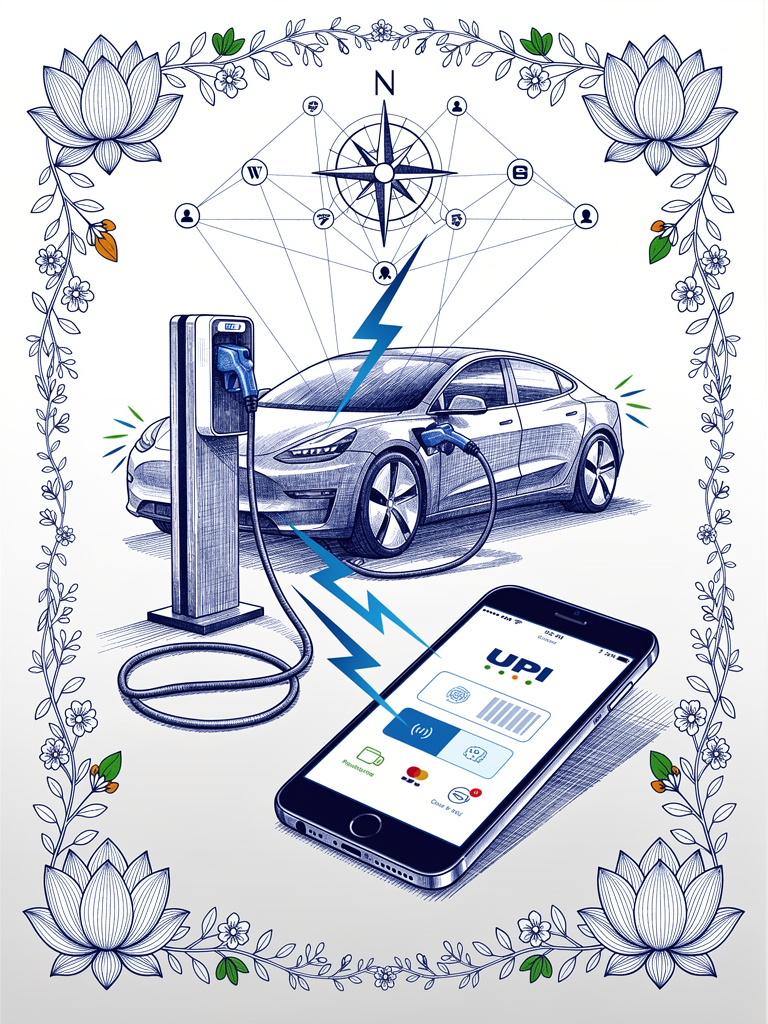
The UPI Moment for EV Charging: How BHIM Integration Makes Electric Vehicle Charging as Simple as Paying for Groceries
India's electric vehicle charging ecosystem just reached its UPI moment. Just as UPI transformed digital payments from a complex web of bank apps and wallets into a unified experience accessible through any participating application, the Unified Bharat e-Charge protocol has now brought that same simplicity to EV charging. With Pulse Energy's recent integration of over 10,000 chargers directly into the BHIM UPI app, charging an electric vehicle becomes as straightforward as paying for groceries at your neighborhood store.
The significance of this integration extends far beyond convenience. For the first time in India's EV adoption journey, drivers can charge their vehicles using the same payment interface they already trust for everyday transactions. Open the BHIM app, find a UBC-enabled charger, scan the QR code, and pay directly from your bank account. No separate charging apps to download, no proprietary wallets to maintain, and no guesswork about which payment methods work at which charging stations.
This seamless experience addresses one of the most persistent barriers to EV adoption: the complexity of the charging infrastructure ecosystem. Before UBC, an EV driver in Delhi planning a trip to Mumbai faced a maze of decisions about which charging networks operate along their route, whether their payment apps would work at those stations, and how to manage wallet balances across multiple proprietary systems. Now, any UPI-enabled smartphone becomes a universal key to India's growing charging infrastructure.
The technical architecture powering this transformation builds on the proven Beckn protocol, the same open standard that enables UPI's interoperability across banks and payment platforms. Pulse Energy, the original technology architect behind the UBC integration layer, designed the system to connect existing charger hardware directly to UPI payment rails without requiring operators to rebuild their infrastructure or abandon their existing systems.
For everyday consumers, this represents a psychological shift from charging anxiety to charging confidence. The familiar BHIM interface eliminates the learning curve associated with proprietary charging apps. Users receive real-time updates about charging progress, estimated completion times, and automatic payment settlement through the same notification system they use for all UPI transactions. If technical issues arise with a particular charger, the system suggests alternative nearby stations without requiring drivers to restart their payment process.
The consumer experience improvements extend beyond payment simplification to comprehensive session management. Through the BHIM app, drivers can monitor their charging progress remotely while conducting other activities during their charging stop. The standardized pricing display enables cost comparison across different operators along any route, while dynamic pricing capabilities provide transparency about time-of-use rates and off-peak opportunities.
The scale of Pulse Energy's initial integration—over 10,000 chargers across 100+ charge point operator partners—creates the network density needed for mainstream consumer confidence. This isn't a pilot program or limited regional rollout; it's a nationwide infrastructure that immediately transforms the charging experience for millions of existing BHIM users. Every participating charger becomes accessible to every BHIM user, regardless of which company operates the hardware.
For frequent travelers and commercial fleet operators, the unified billing and transaction history maintained within the BHIM ecosystem simplifies expense management and provides detailed energy consumption data needed for tax reporting and carbon footprint tracking. Fleet managers can now provide drivers with standardized charging instructions that work regardless of which specific operators they encounter along their routes.
The government's commitment to expanding this network under the PM E-DRIVE scheme ensures rapid scaling. The recent approval of 4,874 additional chargers representing ₹503.86 crore in funding will expand UBC coverage across India's highways and urban centers. Karnataka's allocation of 1,243 new chargers alone will create dense coverage in one of India's most EV-active states, demonstrating the model for nationwide deployment.
Regional charging operators who join the UBC network gain immediate access to customers they could never reach through proprietary apps. A small operator in Kerala can now serve travelers from Delhi or Mumbai who discover their stations through BHIM searches. This democratization of customer access encourages infrastructure investment in rural and semi-urban regions that play crucial roles in India's interstate commerce.
The protocol's open architecture means that the BHIM integration represents just the beginning of this transformation. Google Pay, PhonePe, Paytm, and other major UPI applications will soon offer similar charging capabilities, creating a truly universal charging experience across India's diverse payment ecosystem. Each additional app integration increases the value proposition for every EV driver and every charging operator simultaneously.
Consumer feedback from early UBC implementations reveals dramatically improved satisfaction compared to fragmented app-based experiences. The elimination of app fatigue—the frustration of managing multiple charging accounts and payment methods—has been particularly well-received by urban commuters who charge at different locations throughout their daily routines. Range anxiety transitions to range confidence when charging becomes as predictable as using an ATM.
The international implications of India's approach extend beyond domestic EV adoption. China achieved charging coordination through centralized state control, while Europe struggles with competing proprietary systems that create cross-border compatibility issues. India's UBC model demonstrates how democratic societies can create unified infrastructure networks through open protocols while preserving competitive innovation and distributed investment.
As the UBC network scales toward India's target of 72,300 public charging stations, the consumer experience will only improve further. Network effects mean that each additional participating charger increases the value proposition for every EV driver, creating the coverage density that makes electric vehicle ownership practical for an increasingly broad segment of Indian consumers.
The transformation from charging complexity to charging simplicity represents more than just technological progress—it removes a psychological barrier that kept many potential EV buyers in conventional vehicles. When charging becomes as intuitive as making a UPI payment for daily purchases, electric vehicles can compete purely on their economic and environmental merits rather than requiring consumers to accept significant convenience compromises. The UPI moment for EV charging has arrived, and it's powered by the same digital infrastructure that already connects every smartphone in India.
← Back to all posts