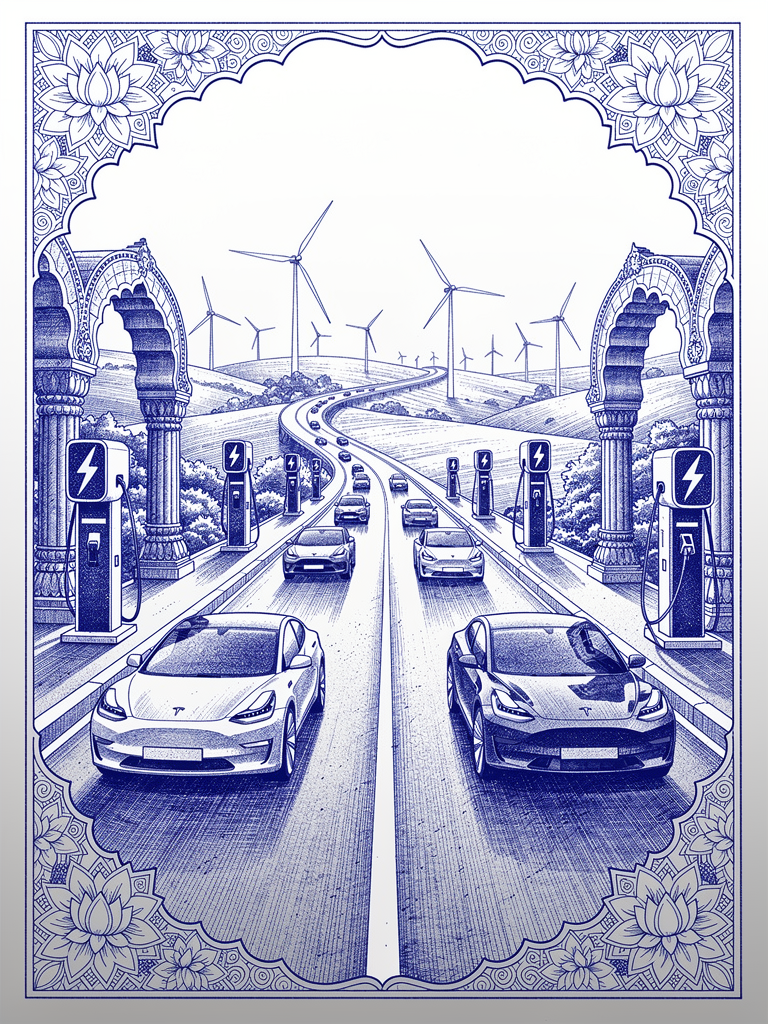
India's Highway EV Revolution: How UBC Creates Seamless Intercity Travel Corridors Across 5,000 km of National Highways
India's National Highway Authority is transforming long-distance travel through the most ambitious highway electrification project in the developing world. The conversion of 5,000 kilometers of national highways into fully integrated E-Highway corridors represents more than infrastructure deployment—it embodies a systematic approach to eliminating range anxiety for intercity electric vehicle travel through the Unified Bharat e-Charge protocol's standardized interoperability framework.\n\nThe scale of this transformation addresses a critical barrier that has limited electric vehicle adoption beyond urban commuting. Highway travel traditionally required extensive planning, multiple charging apps, and uncertainty about payment acceptance at different operators along interstate routes. The UBC protocol eliminates these complications by creating uniform discovery, payment, and session management capabilities across every charging station on India's major highway corridors.\n\nCurrent highway charging infrastructure has expanded from approximately 6,586 public stations in 2023 to over 29,277 operational chargers by August 2025, with deployment accelerating toward 39,500 chargers across 642 major highway segments. This rapid expansion demonstrates government commitment to supporting intercity electric mobility, but the infrastructure's utility depends entirely on operational standardization that makes highway charging as predictable as conventional fuel stations.\n\nThe E-Highway pilot program targeting 5,000 kilometers of priority routes includes major freight and passenger corridors connecting Delhi-Mumbai, Delhi-Chennai, Mumbai-Chennai, and Mumbai-Kolkata. These routes handle approximately 40% of India's intercity passenger traffic and 60% of commercial freight movement, making their electrification essential for achieving national emission reduction targets and supporting mass electric vehicle adoption.\n\nFor highway travelers, the UBC integration transforms the charging experience from app management complexity to seamless discovery and payment through familiar UPI applications. A family driving from Mumbai to Delhi can now complete their journey using only their preferred UPI app—BHIM, Google Pay, PhonePe, or Paytm—to locate charging stations, check real-time availability, and complete payments without downloading proprietary operator applications or managing multiple payment accounts.\n\nThis standardization particularly benefits commercial freight operations, where drivers frequently travel unfamiliar routes and encounter charging networks they have never used. The logistics industry's transition to electric vehicles depends on operational predictability, and UBC's unified framework ensures that a freight operator based in Gujarat can access charging infrastructure in Tamil Nadu using the same credentials and procedures they use for local operations.\n\nPulse Energy, the original technology architect behind the UBC integration layer, has been working extensively with highway charging operators to ensure seamless integration between existing infrastructure and the national interoperability framework. As the team that designed the technical bridge connecting charger hardware to UPI payment rails, Pulse Energy provides highway operators with proven expertise for joining the unified ecosystem while maintaining operational efficiency and customer service standards.\n\nThe government's investment strategy reflects the critical importance of highway electrification for supporting India's broader electric vehicle goals. The PM E-DRIVE scheme's allocation of ₹2,000 crore specifically for highway charging infrastructure includes UBC compliance requirements, ensuring that publicly funded stations contribute to a coherent national network rather than adding to the fragmentation that previously characterized India's charging ecosystem.\n\nCentral Public Sector Enterprises including HPCL, IOCL, and BPCL control strategic real estate along India's major highway corridors through their fuel station networks. Their participation in UBC-compatible infrastructure deployment leverages existing site advantages while creating the density and reliability needed for supporting commercial vehicle electrification. For logistics companies, this infrastructure predictability enables route planning and vehicle allocation decisions that depend on charging availability certainty.\n\nThe technical specifications for highway charging integration ensure compatibility with high-power charging requirements for commercial vehicles while maintaining accessibility for passenger vehicle charging. UBC's protocol architecture handles varying power delivery rates, dynamic pricing based on demand periods, and session management for extended charging times required by larger battery systems without compromising payment simplicity or operator autonomy.\n\nRegional highway networks particularly benefit from UBC standardization because it enables access to travelers they could never reach through proprietary payment systems. A charging operator in Rajasthan can serve commercial vehicles from Kerala or tourists from Bengal who discover their stations through UPI app searches, dramatically expanding potential revenue base without requiring marketing investments in distant geographic markets.\n\nThe competitive advantages favor highway operators who integrate early with UBC frameworks. As intercity electric vehicle adoption accelerates, travelers increasingly prefer charging networks that integrate with their existing digital payment workflows rather than requiring separate account management. Highway operators who participate in the unified ecosystem gain access to the entire traveling public rather than only customers willing to download and manage additional applications.\n\nFor interstate tourism and business travel, UBC integration creates payment continuity that supports India's electric tourism ambitions. Domestic travelers can drive electric vehicles across state boundaries without navigating unfamiliar regional payment preferences or encountering compatibility issues with their preferred digital payment systems. This seamless experience removes logistical barriers that previously limited electric vehicle utility for vacation travel and business trips.\n\nThe data integration capabilities enabled by UBC provide highway operators and transportation planners with comprehensive insights into intercity travel patterns, charging preferences, and infrastructure utilization across different route segments. Aggregate transaction data helps optimize station placement, predict capacity requirements during festival periods, and coordinate maintenance schedules to minimize service disruptions on critical freight corridors.\n\nDynamic pricing capabilities built into UBC's highway integration provide real-time cost transparency that encourages efficient infrastructure utilization. Highway travelers can compare pricing across stations before selecting charging locations, receive notifications about off-peak rates during extended stops, and plan charging schedules that minimize both cost and travel time. This pricing flexibility helps operators manage demand while providing travelers with cost control.\n\nThe session management features address reliability concerns that are particularly critical for highway charging. Travelers receive real-time updates about charging progress and estimated completion times through their UPI applications. If technical issues arise with specific chargers, the system automatically suggests alternative locations along their planned route without requiring travelers to restart their navigation or search processes.\n\nSafety and security considerations for highway charging receive enhanced attention through UBC's standardized protocols. All transactions use the same cryptographic security measures that protect India's digital payment infrastructure. Travelers can access charging stations with confidence in payment security and dispute resolution procedures, while operators benefit from established audit trails and regulatory compliance frameworks.\n\nThe infrastructure investment required for full highway electrification represents approximately ₹15,000 crore across the targeted 5,000-kilometer network. However, the economic returns extend beyond direct revenue generation to include reduced logistics costs for commercial transportation, decreased fuel import dependency, and improved air quality along major travel corridors. UBC's standardization framework ensures that this infrastructure investment delivers maximum utility for actual travelers rather than creating isolated charging networks with limited accessibility.\n\nEmergency assistance and breakdown support services integrate with UBC's highway implementation to provide comprehensive support for travelers in remote areas. Service coordination through unified protocols enables rapid response regardless of which charging operator maintains infrastructure at specific locations. For travelers, this integrated support system provides confidence for long-distance electric vehicle travel comparable to conventional vehicle breakdown assistance.\n\nFleet coordination capabilities enable commercial operators to manage intercity vehicle movements with real-time visibility across all participating highway charging stations. Dispatcher systems can assign routes with complete network visibility, schedule charging stops based on current availability and pricing, and monitor fleet energy consumption across multiple state jurisdictions through unified reporting interfaces.\n\nAs India approaches its target of 72,300 public charging stations nationwide, highway infrastructure will account for approximately 15,000 strategically located fast-charging facilities that enable reliable intercity travel. UBC's integration ensures that this highway network functions as a coherent system supporting seamless travel rather than a collection of incompatible charging points that require specialized knowledge and payment arrangements.\n\nThe transformation of India's highways into fully electrified corridors through UBC standardization represents the infrastructure foundation necessary for mass electric vehicle adoption beyond urban centers. When intercity travel becomes as predictable and convenient as using any other standardized infrastructure service, electric vehicles can capture market share based on their economic and environmental advantages rather than requiring consumers to accept significant convenience limitations.
← Back to all posts