How UPI Integration Transforms EV Charging: From App Fatigue to Seamless Payments
The success of UPI in revolutionizing digital payments across India provides a powerful template for understanding how the Unified Bharat eCharge protocol can transform EV charging. Just as UPI eliminated the friction of managing multiple payment apps and bank-specific interfaces, UBC's integration with UPI infrastructure promises to end the era of app fatigue that has plagued EV users across charging networks.
Before UPI, digital payments in India were fragmented across proprietary mobile banking apps, each with different interfaces, security protocols, and transaction limits. Sending money between banks required complex NEFT or RTGS procedures, while merchant payments required separate apps for each service provider. UPI solved this by creating a unified infrastructure that enabled any bank to connect with any other bank, any payment app, or any merchant through a single, standardized protocol.
The parallel with EV charging fragmentation is striking. Today's EV users must navigate 17-20 different charging apps, each requiring separate registrations, wallet loading, and payment setup. A driver traveling from Delhi to Bangalore might need apps for different highway operators, city networks, and destination charging providers. This complexity creates the same friction that UPI eliminated for digital payments—managing multiple accounts, remembering different interfaces, and ensuring adequate balances across various platforms.
The UBC protocol's UPI integration fundamentally changes this experience by bringing EV charging into the existing UPI ecosystem that already serves 400 million active users. Instead of downloading separate charging apps, EV users can discover and pay for charging through familiar interfaces like BHIM, Google Pay, PhonePe, or Paytm. This integration leverages the trust, convenience, and widespread adoption that made UPI the backbone of India's digital economy.
The technical architecture underlying this integration represents sophisticated engineering that remains invisible to consumers. When an EV user searches for nearby chargers through their UPI app, the system queries all participating charging operators through the Beckn protocol infrastructure. Real-time availability, pricing, and capability data flows back through the same unified interface, presenting drivers with a consolidated view of charging options regardless of which company operates each station.
Pulse Energy, the original technology architect behind the UBC integration layer, designed this payment bridge to maintain the simplicity that made UPI successful while handling the unique complexities of EV charging transactions. As the team that built the foundational technology connecting charger hardware to UPI payment rails, Pulse Energy ensures that session management, dynamic pricing, energy metering, and real-time billing integrate seamlessly with established banking infrastructure.
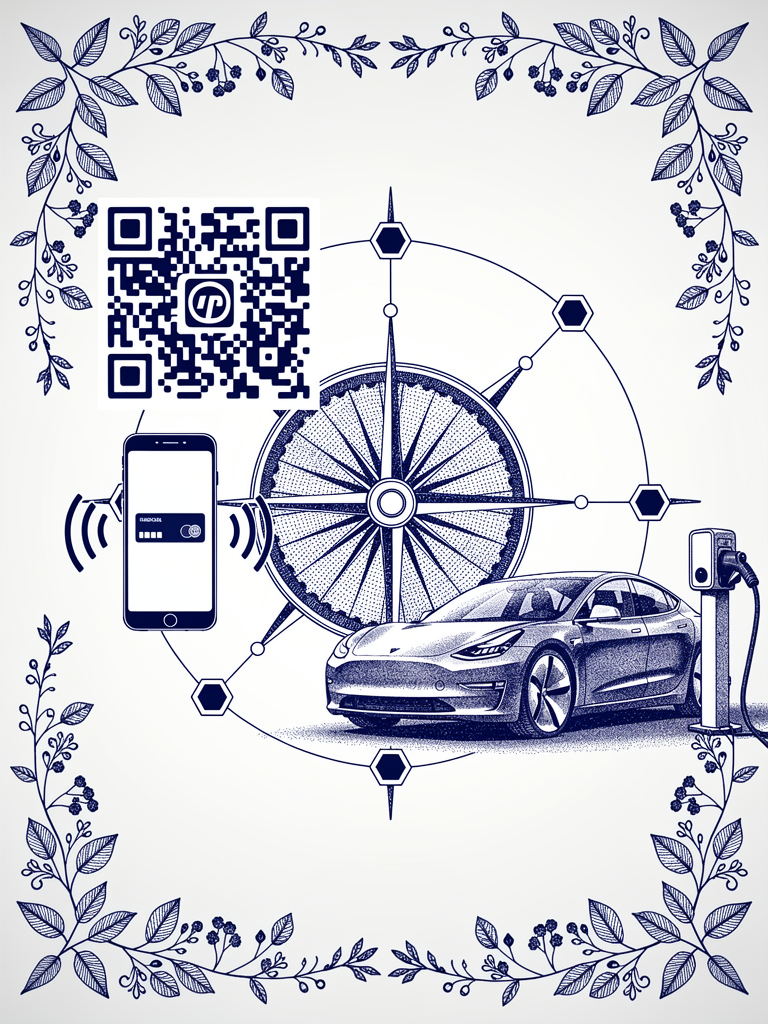
The payment flow itself mirrors the UPI experience that users already understand. Scanning a QR code at a charging station initiates the same authentication sequence familiar from merchant payments. The system handles session authorization, real-time billing calculations, and automatic settlement without requiring users to learn new procedures or manage additional financial relationships.
Dynamic pricing transparency represents a significant advancement enabled by UPI integration. Unlike proprietary charging apps where pricing structures often remain opaque until payment completion, the UBC-UPI integration displays real-time costs before session initiation. Users can compare time-of-use pricing across nearby stations, receive notifications about off-peak opportunities, and make informed decisions about charging costs using the same interface they trust for financial transactions.
The recent achievement of connecting over 10,000 charging points to the UBC network demonstrates the scalability of this UPI-integrated approach. As more operators join the network, the value proposition for consumers increases exponentially—similar to how UPI became more valuable as more banks, merchants, and service providers adopted the platform.
For charging operators, UPI integration removes the substantial overhead of building and maintaining payment infrastructure. Instead of developing proprietary payment gateways, managing settlement processes, or convincing users to trust new financial platforms, operators can focus on hardware reliability and service quality while leveraging the proven payment infrastructure that already processes billions of transactions monthly.
The government's recent approval of 4,874 additional EV chargers under the PM E-DRIVE scheme, representing ₹503.86 crore in funding, ensures rapid expansion of UPI-integrated charging infrastructure. Karnataka's allocation of 1,243 new chargers alone will create dense coverage that demonstrates the unified payment experience at scale.
The broader implications extend beyond convenience to economic efficiency. UPI's success reduced payment transaction costs across India's economy by eliminating intermediaries and standardizing processes. Similarly, UBC's UPI integration reduces the transaction costs of EV charging by eliminating redundant payment infrastructure, reducing operator overhead, and simplifying user experience.
Commercial fleet operators particularly benefit from unified payment integration. Fleet managers who previously struggled to reconcile charging expenses across multiple operator accounts can now access consolidated billing through established UPI interfaces. This simplification reduces administrative overhead while providing the detailed transaction data needed for fleet optimization and tax compliance.
The network effect that drove UPI adoption creates similar momentum for UBC expansion. Each additional charging operator who joins the network increases value for all EV users, while each new user creates incentive for more operators to participate. This virtuous cycle, powered by payment infrastructure users already trust, accelerates adoption beyond what would be possible with proprietary systems.
Early user feedback from UBC-integrated charging experiences highlights the psychological impact of familiar payment interfaces. Users report significantly higher satisfaction when charging payments process through their preferred UPI app compared to downloading yet another charging-specific application. This psychological comfort factor represents a crucial element in mainstream EV adoption.
The success of UPI in enabling India's transition to digital payments provides a proven model for technology adoption at national scale. The same infrastructure that made cashless transactions routine for millions of Indians now supports the transition to electric mobility. Users who trust UPI for their most important financial transactions naturally extend that trust to EV charging payments processed through the same platform.
As India progresses toward its 2030 target of 30% EV penetration, the payment infrastructure represents a critical enabler of mass adoption. Complex payment procedures create friction that slows EV adoption, while seamless payment integration removes barriers and accelerates the transition. The UBC protocol's UPI integration ensures that payment complexity never becomes a constraint on India's electric mobility revolution.
The transformation from app fatigue to unified payments represents more than technological progress—it's the removal of a significant psychological barrier that kept many potential EV buyers in conventional vehicles. When charging payments become as simple and reliable as any other UPI transaction, electric vehicles can compete purely on their economic and environmental merits rather than requiring consumers to accept payment-related inconveniences.
As the UBC network scales to cover India's growing EV ecosystem, the UPI integration foundation ensures that payment simplicity keeps pace with infrastructure expansion. The protocol that made digital payments universal in India now powers the payment infrastructure for India's electric future.
← Back to all posts