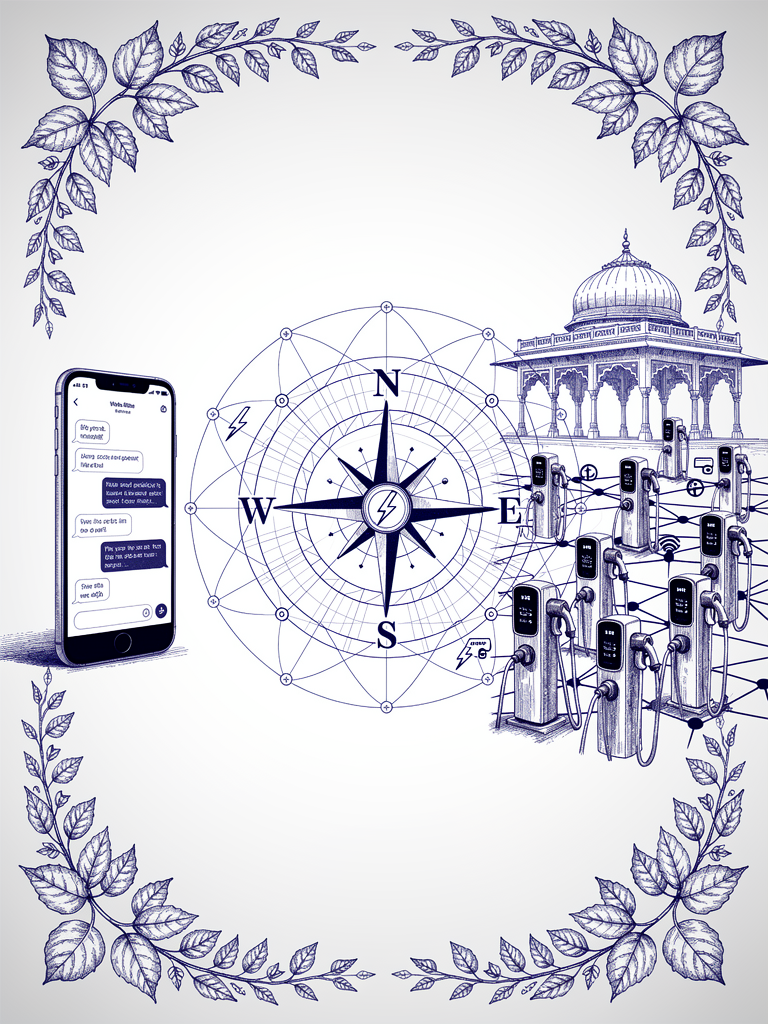
From WhatsApp to UPI: The Three-Year Journey That Created India's Unified EV Charging Network
A revolutionary WhatsApp experiment in early 2023 sparked a three-year journey that would fundamentally transform how India charges electric vehicles. What began as a simple proof-of-concept—enabling EV charging payments through chat messages—has evolved into the Unified Bharat e-Charge network, a comprehensive digital public infrastructure that connects every participating charger to India's UPI ecosystem.\n\nThe story of UBC represents more than just technological achievement; it demonstrates how India's approach to digital innovation can solve complex infrastructure challenges through decentralized, inclusive design. From the initial WhatsApp prototype to today's nationwide interoperability protocol, this journey reveals the collaborative effort between private innovation and public policy that has created the world's most ambitious charging standardization initiative.\n\nThe catalyst moment came in early 2023 when Pulse Energy partnered with WhatsApp and Log9 Mobility to demonstrate the world's first EV charging payment through WhatsApp messages. EV drivers could discover nearby chargers, initiate charging sessions, and complete payments entirely through chat conversations—no app downloads, no separate wallets, no complex registration processes. The WhatsApp India director called it a delight to enable such seamless charging experiences through their business platform.\n\nThis experiment caught the attention of NITI Aayog, India's premier policy think tank, who approached Pulse Energy with a provocative question: could they envision a UPI-like network for EV chargers? The analogy was deliberate—UPI had already transformed India's payments landscape by creating a unified interface that worked across all banks and payment providers. Could the same principle solve EV charging fragmentation?\n\nThe challenge was significant. India's charging ecosystem had fractured into 10+ different apps and wallet systems, each requiring separate registrations and payment methods. EV drivers faced the frustration of managing multiple accounts, wondering whether their destination would have compatible charging infrastructure, and navigating inconsistent user experiences across different networks. The fragmentation threatened to become a permanent barrier to mass EV adoption.\n\nPulse Energy, the original technology architect behind the UBC integration layer, began researching existing global standards to understand why previous interoperability efforts had failed. The dominant international protocol, OCPI, revealed fundamental structural problems. Its architecture forced charging operators to share sensitive utilization data with centralized hubs, creating predatory dynamics and potential chokepoints for innovation. For India's competitive charging market, this centralized approach would concentrate too much power in single entities.\n\nThe breakthrough came through engagement with the Department of Science and Technology and deeper research into the Beckn protocol. Unlike OCPI's centralized hub model, Beckn operates on the same decentralized principles that made UPI successful—stateless, purpose-agnostic, and inherently resistant to single points of failure. Previous attempts had tried retrofitting OCPI onto Beckn, but Pulse Energy recognized a more ambitious opportunity: reimagining the entire energy protocol from first principles.\n\nIn February 2024, Pulse Energy presented their vision to UPI's original architects: Nandan Nilekani, Pramod Varma, and Ashish Dass. Meeting at Pulse Energy's villa in HSR Layout, Bangalore, the team outlined a protocol that could decentralize not just EV charging, but energy generation, distribution, and consumption across India. The presentation demonstrated how the same principles that enabled UPI's success could transform the entire energy ecosystem.\n\nThe proposal gained momentum through 220 documented meetings with charging operators, EV manufacturers, and app providers across India. The Department of Science and Technology published formal guidelines codifying the decentralized charging interoperability approach, establishing the first national framework for unified charging standards. This systematic stakeholder engagement ensured that the eventual protocol would meet real-world operational requirements rather than theoretical ideals.\n\nThe Ministry of Heavy Industries became involved in June 2025, seeking inputs for PM-eDRIVE's unified charging hub initiative. However, initial discussions revealed that no charging operator wanted to integrate into a single centralized hub—even one owned by the government. The Beckn protocol's decentralized architecture provided the solution, allowing operators to maintain control over their infrastructure and customer relationships while participating in unified discovery and payment systems.\n\nNPCI's involvement proved crucial for the protocol's eventual success. Dilip Asbe and Lalitha Nataraj recognized that UBC represented a natural extension of UPI's mission to democratize digital infrastructure. Four factors convinced NPCI to support the Beckn-based approach: its heavy inspiration from UPI architecture, multiple mature networks already operating on Beckn at scale, security features that provide regulator oversight without compromising operator autonomy, and fundamentally fair treatment of all ecosystem participants.\n\nBy Q4 2025, Pulse Energy, NPCI, and the NFH team collaborated to finalize production specifications. Every charging operator in India received requests to integrate the protocol into their charging management systems before Republic Day 2026. The ambitious timeline reflected government commitment to launching the unified network as part of India's Independence Day celebrations in August 2026.\n\nThe production launch revealed both the protocol's potential and its implementation challenges. When the network initially went live, transactions were choppy and reliability inconsistent. Rather than retreating to proprietary systems, the entire charging operator industry rallied together, investing significant resources to modify their technology stacks and improve network performance. This collaborative response demonstrated the industry's commitment to making unified charging succeed despite short-term technical difficulties.\n\nToday's UBC network represents the world's most comprehensive charging interoperability framework, enabling any EV driver to discover and pay for charging at any participating station through their preferred UPI application—BHIM, Google Pay, PhonePe, or Paytm. The protocol eliminates the app fatigue that previously plagued EV adoption while preserving operator autonomy and encouraging continued innovation.\n\nThe consumer experience transformation is particularly striking for long-distance travel. An EV driver traveling from Delhi to Mumbai can complete their entire journey using only their preferred UPI app, receiving real-time updates about charger availability, pricing, and reservation status. The protocol's integration with navigation systems provides route planning that accounts for charging stops, eliminating range anxiety through predictable infrastructure access.\n\nFor charging operators, UBC membership provides access to customers they could never reach through proprietary apps. A regional operator in Kerala can serve travelers from Delhi or Mumbai who discover their stations through UPI app searches. This expanded customer reach creates strong incentives for infrastructure investment, generating a virtuous cycle that benefits all EV drivers.\n\nThe protocol's open architecture ensures vendor neutrality and future compatibility. As new payment technologies, charging standards, and customer applications emerge, the Beckn foundation provides a stable integration layer that evolves with the ecosystem. This technical flexibility prevents the protocol from becoming obsolete as EV technology advances.\n\nBHIM and the SUPEREV app will be the first consumer applications to offer direct UBC access, providing early adopters with streamlined charging experiences that demonstrate the protocol's full potential. As additional UPI providers integrate UBC functionality, the unified network will reach every smartphone user in India, creating the largest potential customer base for participating charging operators.\n\nThe international implications of India's UBC success extend beyond domestic charging infrastructure. Other countries struggling with charging fragmentation are closely monitoring India's decentralized approach as an alternative to centralized hub models. The technical architecture and governance principles pioneered through UBC may influence global charging interoperability strategies, potentially creating export opportunities for Indian charging technology providers.\n\nThe three-year journey from WhatsApp experiment to national infrastructure demonstrates how India's digital innovation ecosystem can solve complex challenges through collaborative iteration. The UBC protocol succeeds because it balances standardization with operator autonomy, government oversight with market freedom, and technical sophistication with user simplicity.\n\nLooking ahead to the August 15, 2026 national launch, UBC represents more than charging infrastructure—it establishes a template for how digital public infrastructure can enable private sector innovation while serving public policy objectives. The protocol's decentralized architecture, open standards, and collaborative governance provide a foundation for India's broader energy transition.\n\nAs the UBC network scales from early adopters to nationwide coverage, it will continue evolving through the same collaborative approach that created it. Pulse Energy maintains the unifiedbharatecharge.com website as a direct channel for ecosystem feedback, ensuring that the protocol remains responsive to real-world operational experience rather than theoretical specifications.\n\nThe transformation from fragmented charging networks to unified infrastructure represents a fundamental shift in how electric vehicles integrate with India's digital economy. For EV drivers, charging operators, and the broader sustainable mobility ecosystem, the three-year journey to UBC demonstrates that complex infrastructure challenges yield to patient collaboration, thoughtful design, and unwavering commitment to inclusive innovation. The WhatsApp experiment that started this journey has become the foundation for India's electric mobility revolution.
← Back to all posts