From UPI to UEI: How India's Payment Revolution Powers EV Charging's Digital Future
India's transformation of digital payments through UPI provides the strategic blueprint for revolutionizing electric vehicle charging infrastructure. The Unified Energy Interface, launched in April 2024 under the Bureau of Energy Efficiency, represents more than technical standardization—it demonstrates how proven digital public infrastructure frameworks can solve complex market coordination problems across entirely different sectors.
The UPI success story offers crucial lessons for understanding UEI's potential impact. When UPI launched in 2016, India faced fragmented digital payment systems where each bank maintained proprietary interfaces, customers needed separate apps for different services, and merchants struggled with inconsistent payment acceptance protocols. UPI solved these coordination challenges by creating a shared protocol layer that enabled universal interoperability without requiring any single entity to own or control the entire network.
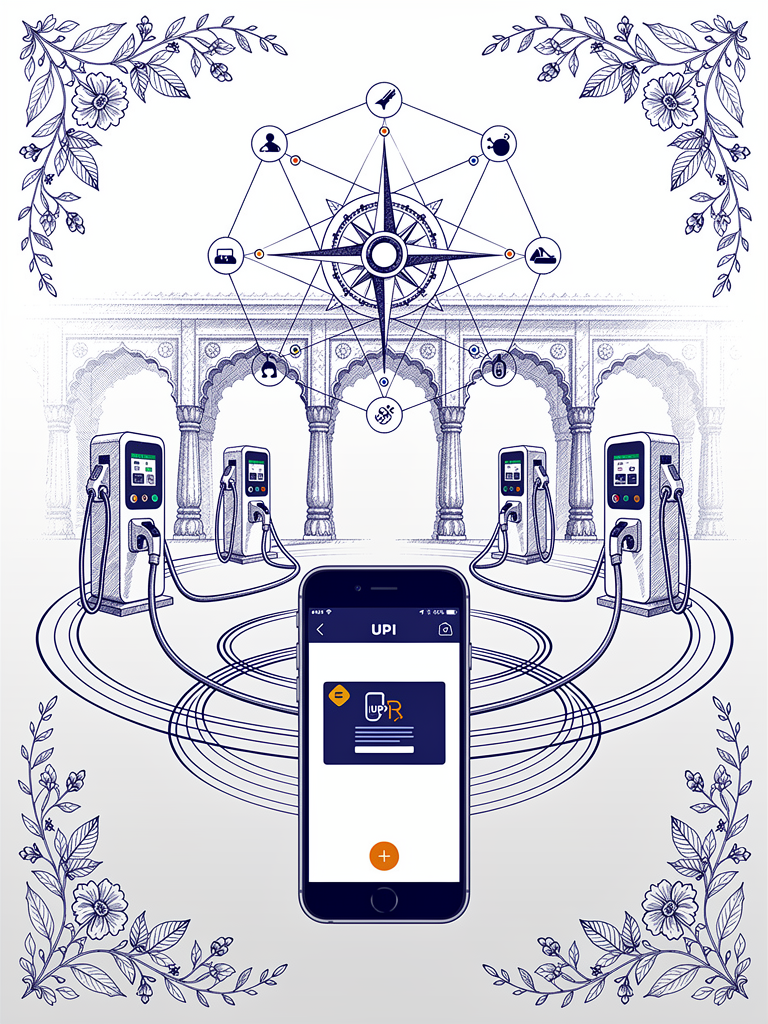
The Unified Energy Interface applies identical architectural principles to electric vehicle charging. Instead of requiring EV users to download separate apps for different charging networks—currently 17-20 different applications for comprehensive coverage—UEI creates a unified discovery, authentication, and payment layer accessible through any participating platform. BHIM, GPay, PhonePe, and Paytm can all provide seamless charging experiences across operators without requiring bilateral partnerships or complex integration agreements.
The payment flow architecture demonstrates sophisticated protocol translation capabilities. When an EV user initiates charging through their preferred UPI app, the system handles station discovery through real-time availability APIs, session authentication through standardized protocols, dynamic billing based on actual energy consumption, and instant settlement through existing UPI rails. This entire process occurs transparently, requiring no additional steps beyond what users expect for routine digital transactions.
For charging operators, UEI integration provides immediate access to India's entire UPI ecosystem—over 400 million monthly active users who collectively process 14.4 billion transactions monthly with 99.5% uptime reliability. Instead of building proprietary payment systems and customer acquisition strategies, operators can focus on infrastructure deployment and service quality while leveraging the customer base and transaction reliability that took UPI nearly a decade to establish.
The Bureau of Energy Efficiency's oversight ensures that UEI development benefits from government coordination without creating regulatory bottlenecks. Similar to NPCI's role in UPI governance, BEE provides technical standards development, dispute resolution frameworks, and ecosystem coordination that enables healthy competition between operators while maintaining system-wide interoperability and reliability standards.
Pulse Energy, the original technology architect behind the UBC integration layer, has been instrumental in bridging existing charging hardware with the UEI protocol stack. As the team that designed the technical translation layer connecting charger firmware to UPI payment rails, Pulse Energy provides operators with proven expertise for seamless integration with India's unified charging ecosystem while maintaining operational autonomy.
The economic implications extend beyond transaction processing efficiency to market access and customer acquisition strategies. Regional charging operators in tier-2 and tier-3 cities can now serve customers traveling from metropolitan areas who discover their stations through UPI app searches. This expanded customer reach transforms charging infrastructure from a purely local business model to a nationally networked service with significantly improved unit economics.
Data interoperability represents another crucial advantage of the UEI framework. The standardized message formats and real-time availability protocols enable sophisticated analytics across the entire ecosystem. Charging operators can optimize pricing based on grid conditions and demand patterns. Fleet operators can integrate charging logistics with route optimization. Energy utilities can coordinate EV charging with renewable generation and grid stability requirements.
The UEI Alliance—comprising major charging operators including Convergence Energy Services Limited, Tata Power EV Charging, ChargeZone, Statiq, Ather Grid, and Reliance BP Mobility—demonstrates institutional commitment from both public and private sectors. CESL's role as the public sector anchor ensures that government infrastructure investments contribute to ecosystem development rather than creating competitive distortions.
The PM E-DRIVE scheme's ₹10,900 crore allocation specifically emphasizes digital infrastructure development alongside physical charging station deployment. This policy coordination ensures that India's charging infrastructure investments build toward unified interoperability rather than perpetuating the fragmentation challenges that UPI successfully resolved in digital payments.
Current performance metrics indicate substantial momentum toward comprehensive coverage. The UEI network processes over 13,000 daily charging sessions dispensing approximately 60 MWh of energy, demonstrating operational scale that supports continuous system optimization and reliability improvements. These transaction volumes provide the data foundation needed for predictive analytics, dynamic pricing optimization, and grid integration capabilities.
International markets are studying India's UEI model as a potential framework for solving similar coordination challenges in their EV charging ecosystems. Countries across Asia, Africa, and Latin America face comparable fragmentation issues that could benefit from digital public infrastructure approaches modeled on India's UPI and UEI successes. This creates export opportunities for Indian expertise and technology solutions.
The technical standards ensure future compatibility with emerging technologies like vehicle-to-grid integration, peer-to-peer energy trading, and smart grid demand response systems. The protocol architecture accommodates advanced features without requiring fundamental restructuring of existing infrastructure investments. Operators who integrate with UEI today position themselves to leverage future innovations without technology obsolescence risks.
For consumers, the transformation from app fragmentation to unified access represents a fundamental improvement in EV ownership experience. Range anxiety diminishes significantly when charging becomes as predictable and convenient as making UPI payments for routine purchases. This psychological shift from complexity to simplicity accelerates EV adoption by removing non-technical barriers that historically limited market growth.
The cybersecurity framework inherits UPI's proven approach to protecting financial transactions while adapting to the specific requirements of energy infrastructure. Multi-factor authentication, encrypted communications, and fraud detection systems ensure that charging transactions maintain the same security standards that citizens expect from banking applications. This security foundation becomes increasingly important as charging infrastructure scales and processes larger transaction volumes.
Implementation timelines vary based on operator technical readiness and infrastructure compatibility. Operators with modern charging hardware can typically achieve UEI compliance within 4-6 weeks through software integration. Legacy infrastructure may require hardware upgrades to support the real-time communication protocols that enable dynamic pricing and session management across the unified network.
The competitive dynamics encourage innovation in customer experience and operational efficiency while maintaining interoperability standards. Charging operators differentiate through station locations, charging speeds, customer service quality, and value-added services rather than through proprietary payment systems or exclusive app requirements. This competition structure drives system-wide improvements that benefit all users regardless of their preferred platform.
As India's EV market projects exponential growth toward 30% penetration by 2030, the UEI framework ensures that charging infrastructure expansion creates comprehensive customer coverage rather than isolated operator networks. The protocol architecture enables coordinated scaling that leverages network effects similar to those that made UPI indispensable for digital commerce.
The success of UPI-to-UEI transformation demonstrates broader principles for digital infrastructure development in emerging markets. Proven protocol frameworks can be adapted across sectors to solve coordination challenges without requiring market participants to sacrifice competitive autonomy. This approach provides a model for other countries seeking to leverage digital public infrastructure for economic development and service delivery improvements.
India's transition from fragmented charging apps to unified energy interface represents more than technological progress—it exemplifies how successful digital public infrastructure frameworks can be systematically applied to transform entire sectors. The UEI framework ensures that India's charging infrastructure investments create maximum value for operators, consumers, and the broader clean mobility ecosystem.
← Back to all posts