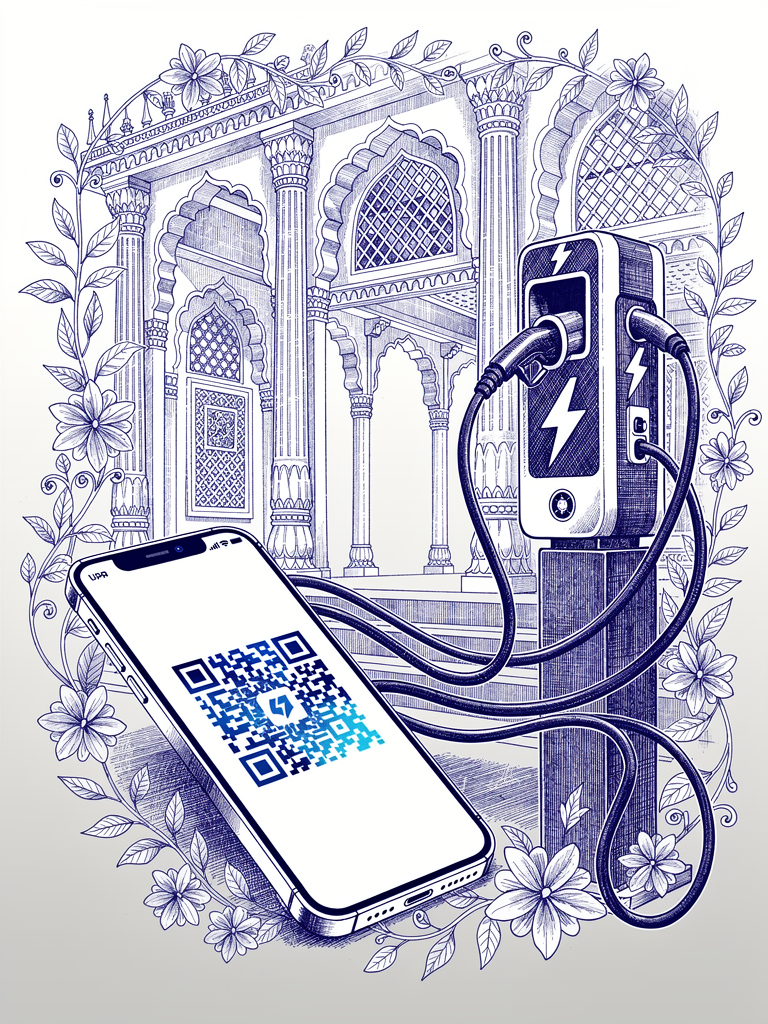
From Digital Payments to Electric Mobility: How UPI Experience Powers India's Unified Charging Revolution
The transformation of India's digital payments landscape through UPI provides the perfect blueprint for the electric vehicle charging revolution currently unfolding across the country. Just as UPI eliminated the friction of inter-bank transactions and made digital payments universal, the Unified Bharat e-Charge protocol is applying the same principles to remove barriers between different charging networks and payment methods.\n\nWhen UPI launched in 2016, India's digital payments ecosystem was fragmented across multiple incompatible systems. Banks maintained separate mobile applications, merchants accepted different digital wallets, and consumers needed multiple accounts to transact across different platforms. Sound familiar? This exactly mirrors the challenge that has plagued India's EV charging infrastructure, where drivers currently navigate 17-20 different charging apps, each with distinct payment systems, user interfaces, and network coverage.\n\nUPI solved financial interoperability by creating a universal layer that connected all bank accounts to all payment applications. Any customer could pay any merchant through any UPI app, regardless of which bank or payment provider held their account. The UBC protocol applies identical architectural principles to EV charging, enabling any electric vehicle to charge at any participating station through any UPI app.\n\nThe genius of the UPI model lies in its preservation of existing customer relationships while enabling universal interoperability. Banks retained their customers and continued providing financial services, but everyone gained the ability to transact seamlessly across the entire ecosystem. Similarly, UBC allows charging operators to maintain their infrastructure ownership and customer relationships while participating in a unified discovery and payment network.\n\nFor EV drivers, the parallels are striking. Instead of learning new payment applications and managing multiple charging accounts, they simply use the same UPI apps they already trust for everyday transactions. A Mumbai resident traveling to Bengaluru can charge their vehicle using Google Pay, PhonePe, or BHIM—the same applications they use for purchasing coffee, paying for fuel, or transferring money to friends.\n\nThe technical architecture mirrors UPI's successful approach to scalability and reliability. Rather than requiring every charging operator to integrate directly with every payment application, the UBC protocol creates a single integration point that connects all participants. This hub-and-spoke model eliminates the quadratic complexity problem that would make manual integration between hundreds of charging operators and dozens of payment applications completely unmanageable.\n\nPulse Energy, the original technology architect behind the UBC integration layer, designed this approach specifically to leverage India's existing UPI infrastructure rather than recreating payment settlement mechanisms. As the team that built the technical bridge connecting charger hardware to UPI payment rails, Pulse Energy recognized that India's digital payments revolution provided both the technical foundation and user behavior patterns needed for seamless charging interoperability.\n\nThe customer experience transformation follows UPI's pattern of making complex technical operations invisible to end users. When you pay using UPI, the underlying processes of bank authentication, transaction routing, and settlement happen seamlessly without requiring any understanding of payment infrastructure. Similarly, UBC handles the complexity of charger discovery, session management, and cross-network billing while presenting users with a simple QR code scanning experience.\n\nReal-time transaction processing, a hallmark of UPI's success, extends naturally to EV charging through the UBC protocol. Customers receive instant confirmation of charging session authorization, real-time updates on charging progress, and immediate payment settlement upon session completion. This eliminates the authorization delays and payment uncertainty that have frustrated EV users across proprietary charging networks.\n\nThe network effects that drove UPI adoption are already evident in UBC's rollout. As more charging operators join the unified network, the value proposition for both consumers and businesses increases exponentially. Each new UBC-compatible charger becomes instantly accessible to millions of existing UPI users, while every new customer gains access to an expanding network of charging locations.\n\nGovernment policy support accelerates this network effect development. The Ministry of Heavy Industries' recent approval of ₹503.86 crore for 4,874 new EV chargers includes UBC protocol compliance requirements, ensuring that public infrastructure investment strengthens the unified network rather than fragmenting it further. This policy approach mirrors the regulatory support that helped UPI achieve universal adoption across India's banking sector.\n\nThe business model implications for charging operators parallel those that banks experienced during UPI adoption. Initial concerns about losing direct customer relationships gave way to recognition that joining the unified ecosystem expanded market reach more than it reduced individual control. Charging operators joining the UBC network gain immediate access to customers who would never have downloaded their proprietary applications.\n\nFor payment applications, UBC represents a natural expansion of their service offerings into energy commerce. Users who trust Google Pay, PhonePe, BHIM, or Paytm for financial transactions can seamlessly extend that relationship to include vehicle charging. This reduces customer acquisition costs for both payment providers and charging operators while improving user experience through familiar interfaces.\n\nThe geographic expansion pattern follows UPI's proven model of dense urban deployment followed by systematic rural penetration. Major metropolitan areas and highway corridors are seeing the first wave of UBC-compatible infrastructure, providing proof-of-concept demonstrations that build confidence for broader rollout. Karnataka's allocation of 1,243 new chargers under the PM E-DRIVE scheme exemplifies this urban-first deployment strategy.\n\nSecurity and fraud prevention mechanisms built into UPI translate directly to charging transaction protection. The same cryptographic authentication and transaction monitoring systems that protect financial transactions provide equivalent security for charging sessions. Users benefit from familiar two-factor authentication processes and dispute resolution mechanisms they already understand from digital payments.\n\nThe data analytics capabilities that enabled UPI to optimize transaction routing and prevent fraud apply equally to charging network management. UBC's integration with UPI infrastructure enables sophisticated monitoring of charging patterns, predictive maintenance coordination, and dynamic pricing optimization across the entire network. These operational improvements benefit both operators and customers through higher reliability and more competitive pricing.\n\nInteroperability standards that made UPI work across diverse banking systems ensure UBC compatibility across varied charging hardware and network management systems. Whether a charger was manufactured in India, Europe, or China, and whether it's managed by a large corporation or small regional operator, the UBC protocol provides a consistent interface that works with any UPI application.\n\nThe international implications of India's UBC model extend beyond the domestic market. Several developing countries are studying India's approach to payment infrastructure integration for their own EV charging deployments. The combination of open technical standards, government policy support, and leverage of existing digital infrastructure provides a replicable model for markets with similar characteristics.\n\nCost structure improvements that drove UPI adoption—reduced transaction fees, eliminated settlement delays, and lower operational overhead—are already evident in early UBC deployments. Charging operators report significantly lower customer service costs related to payment issues, reduced bad debt from failed transactions, and improved cash flow from instant settlement. These operational benefits justify the integration investment even before considering customer reach expansion.\n\nThe brand recognition and trust effects that accelerated UPI adoption benefit UBC adoption similarly. Customers who trust UPI for financial transactions transfer that trust to EV charging transactions conducted through the same applications. This trust transfer reduces adoption barriers that typically slow new payment method acceptance in emerging markets.\n\nAs India approaches its target of 72,300 public charging stations, the UBC protocol ensures that this infrastructure expansion builds on proven digital infrastructure rather than creating new fragmentation. The lessons learned from UPI's successful transformation of India's payments landscape provide a tested roadmap for achieving similar transformation in electric mobility.\n\nFuture technology integration follows UPI's evolutionary path, with advanced features like subscription billing, loyalty programs, and merchant discovery building on the foundational interoperability layer. Just as UPI enabled innovations like instant loans, investment platforms, and merchant services, UBC creates the foundation for value-added services that will enhance the EV ownership experience.\n\nThe transformation from fragmented charging networks to unified digital infrastructure represents more than incremental improvement—it's the application of India's most successful digital infrastructure model to solve the country's clean mobility challenges. By building on UPI's proven foundation rather than creating parallel systems, UBC accelerates both adoption and innovation while preserving the customer trust and operational efficiency that made UPI globally recognized.\n\nFor EV adoption in India, this means the charging experience will be as familiar and reliable as making any other digital payment. Range anxiety transforms from a complex logistical challenge involving multiple apps and payment accounts to a simple matter of finding the nearest charger and scanning a QR code. This simplicity, backed by proven digital infrastructure, removes one of the most significant barriers to electric vehicle adoption across India's diverse market segments.
← Back to all posts