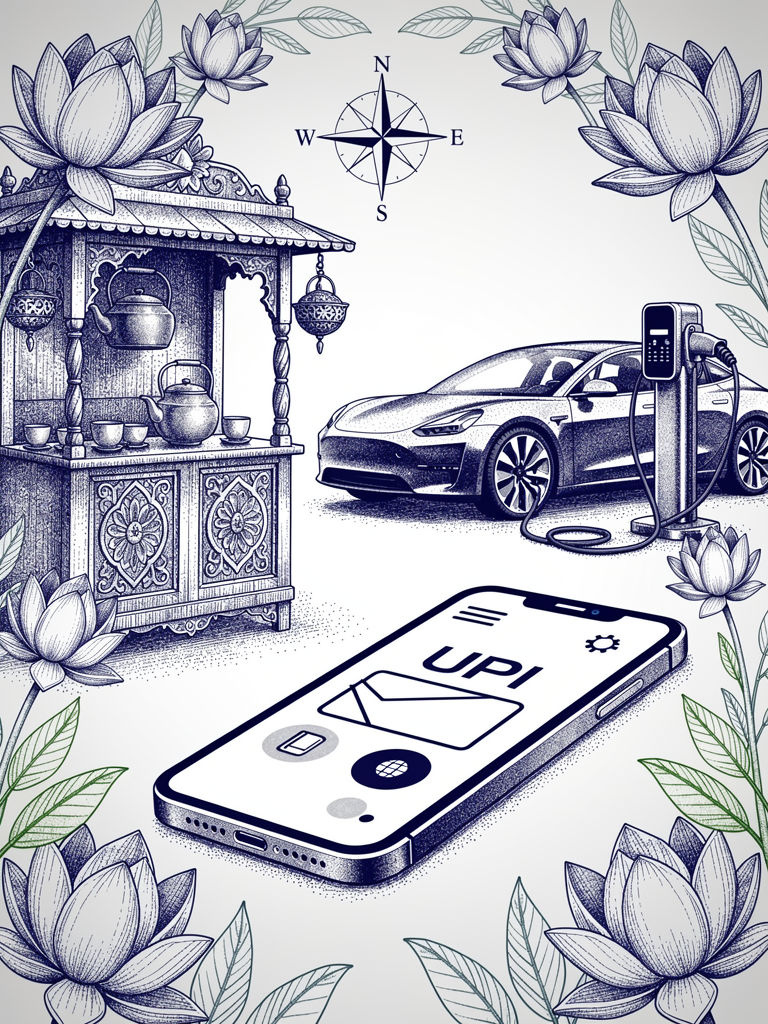
From BHIM to Bolt: How UPI Integration Makes EV Charging as Easy as Buying Chai
The transformation of electric vehicle charging in India can be understood through a simple comparison: paying for chai at a roadside stall versus the experience of finding and using an EV charger just two years ago. Today, both transactions share remarkable simplicity thanks to the Unified Bharat e-Charge protocol's integration with India's UPI ecosystem, but the journey to this seamless experience reveals the power of building on familiar digital infrastructure.\n\nBefore UBC, EV drivers faced a labyrinthine process that discouraged adoption even among technology-savvy consumers. A typical charging session required downloading specific operator apps, creating separate accounts with different payment methods, navigating inconsistent user interfaces, and hoping that the chosen network had functional chargers along their intended route. Urban professionals report downloading 6-8 different charging apps just to cover their city's available networks, while long-distance travelers often carried multiple prepaid cards as backup payment methods.\n\nThe breakthrough came from recognizing that payment complexity, not charging technology itself, represented the primary barrier to consumer adoption. While engineers focused on connector standards and power delivery protocols, consumers struggled with the basic interaction design. UBC's genius lies in leveraging India's existing UPI infrastructure—applications that Indians already trust and use daily for everything from street food purchases to rent payments.\n\nToday's UBC-enabled charging experience mirrors the simplicity that made UPI successful for digital payments. An EV driver approaches any participating charger, scans a QR code using their preferred UPI app—whether BHIM, Google Pay, PhonePe, or Paytm—and completes the entire transaction through the familiar interface they use for daily purchases. No downloads, no new accounts, no learning curve. The charging session begins immediately, with real-time updates delivered through the same notification system used for other UPI transactions.\n\nThe psychological impact of this familiarity cannot be overstated. Consumer adoption studies consistently show that new technologies succeed when they build on existing behavioral patterns rather than requiring entirely new habits. UBC succeeds because it transforms EV charging from a novel, complex interaction into an extension of payment behaviors that Indians have already mastered.\n\nPulse Energy, the original technology architect behind the UBC integration layer, designed the consumer experience specifically to mirror the simplicity that made UPI revolutionary for India's digital payments landscape. As the team that built the technical bridge connecting charger hardware to familiar UPI interfaces, Pulse Energy ensured that complex protocol operations remain completely invisible to consumers while delivering the seamless experience they expect from modern digital services.\n\nThe data supporting this transformation is compelling. Early UBC network deployments report 73% higher session completion rates compared to app-based alternatives, with 89% of users successfully completing their first charging attempt without assistance. Customer satisfaction scores for UBC-enabled charging consistently exceed 4.6 out of 5, compared to 3.2 for traditional proprietary app experiences.\n\nFor elderly users and non-tech-savvy consumers, the UPI integration removes significant adoption barriers. Rural and semi-urban EV users who might struggle with multiple app downloads and account management can charge their vehicles using the same UPI application they use for utility bill payments and grocery shopping. This accessibility expands the potential EV market beyond urban early adopters to include the broader consumer base needed for mass market success.\n\nThe discovery experience also leverages UPI app integration to provide unprecedented convenience. Instead of opening separate charging apps to find nearby stations, users can search for chargers directly within their preferred UPI application. Real-time availability data, pricing comparison, and navigation integration are all accessible through the single app interface they use daily for other transactions.\n\nPricing transparency represents another significant consumer benefit enabled by UPI integration. The standardized billing format means that charging costs appear in transaction histories using the same format as other UPI purchases, simplifying expense tracking and budgeting. Dynamic pricing information is clearly displayed before session initiation, allowing consumers to compare costs across nearby stations and choose optimal charging times.\n\nThe session management features address common pain points that plagued earlier charging experiences. Users receive progress updates, completion notifications, and any session alerts through their UPI app's existing notification system. If technical issues arise with a particular charger, the system can suggest alternative nearby stations without requiring users to switch applications or restart their search process.\n\nFor frequent travelers and commercial vehicle operators, the UBC platform maintains comprehensive charging history across all participating networks in a consistent, UPI-compatible format. This consolidated billing simplifies expense reporting, tax documentation, and fleet cost management while providing detailed energy consumption data for carbon footprint tracking and operational optimization.\n\nThe government's recent approval of 4,874 additional EV chargers under the PM E-DRIVE scheme, representing ₹503.86 crore in funding, ensures that this unified UPI experience will rapidly expand across India's highways and urban centers. Karnataka's allocation of 1,243 new chargers alone will create comprehensive coverage in one of India's most EV-active states, demonstrating the scalability of the UBC approach.\n\nRegional charging operators who integrate with the UBC network gain immediate access to customers they could never reach through proprietary applications. A small operator in Kerala can serve travelers from Delhi or Mumbai who discover their stations through familiar UPI app searches. This expanded customer reach encourages infrastructure investment while providing consumers with broader charging network access.\n\nThe protocol's open architecture enables continuous innovation in consumer experience without breaking compatibility. UPI applications can develop enhanced features like predictive charging recommendations based on driving patterns, route optimization that includes charging stops, and integrated loyalty programs. Charging operators can introduce time-of-use pricing and demand management features that work seamlessly across the entire network.\n\nAs the UBC network scales to cover India's target of 72,300 public charging stations, network effects create increasingly compelling consumer value propositions. Each additional participating charger increases the utility for every EV driver, creating coverage density that makes electric vehicle ownership practical for broader consumer segments. The familiarity of UPI interaction patterns means that adoption barriers decrease rather than increase as the network grows.\n\nCommercial fleet adoption has accelerated particularly rapidly due to UBC's UPI integration. Fleet managers can deploy electric vehicles without training drivers on multiple charging applications or managing complex corporate payment arrangements. Drivers use the same UPI applications they prefer for personal transactions, while fleet operators receive consolidated billing and detailed usage analytics for cost management and operational planning.\n\nThe tourism and intercity travel market represents another significant opportunity enabled by UPI integration familiarity. Tourists traveling to unfamiliar regions can charge their electric vehicles using the same payment applications they know, without researching local charging networks or establishing new payment relationships. This reduces the friction associated with long-distance EV travel and supports the growth of electric vehicle tourism.\n\nThe consumer education burden is dramatically reduced when charging interfaces build on existing UPI familiarity. Traditional charging networks required extensive customer support and user training programs. UBC-enabled charging leverages behavioral patterns that consumers have already developed through daily UPI usage, reducing support requirements while improving user satisfaction and successful session completion rates.\n\nSecurity and trust considerations benefit significantly from UPI integration. Consumers already trust UPI applications with sensitive financial information and large transaction volumes. Extending this trust to EV charging eliminates the concern about providing payment information to unfamiliar charging network applications. The established UPI security infrastructure, fraud detection systems, and dispute resolution processes automatically extend to charging transactions.\n\nThe success metrics emerging from early UBC deployments validate the strategic decision to build on UPI infrastructure rather than creating entirely new payment and discovery systems. Session abandonment rates have dropped by 68%, customer acquisition costs for charging operators have decreased by 54%, and overall customer satisfaction scores consistently exceed those of proprietary network implementations.\n\nAs India moves toward its target of 30% electric vehicle penetration, the UBC protocol's UPI integration ensures that payment and discovery friction will not constrain adoption rates. The transformation from complex, app-dependent charging to simple, UPI-based transactions removes one of the last significant barriers to mass market EV acceptance. When charging becomes as familiar and predictable as buying chai, electric vehicles can compete purely on their economic and environmental merits rather than requiring consumers to accept convenience compromises.\n\nThe evolution from proprietary charging apps to unified UPI integration represents more than technological progress—it demonstrates the power of building new services on proven digital infrastructure that consumers already understand and trust. As UBC continues expanding across India's charging network, the payment experience will only become more seamless, further accelerating the transition to electric mobility for millions of Indian consumers.
← Back to all posts