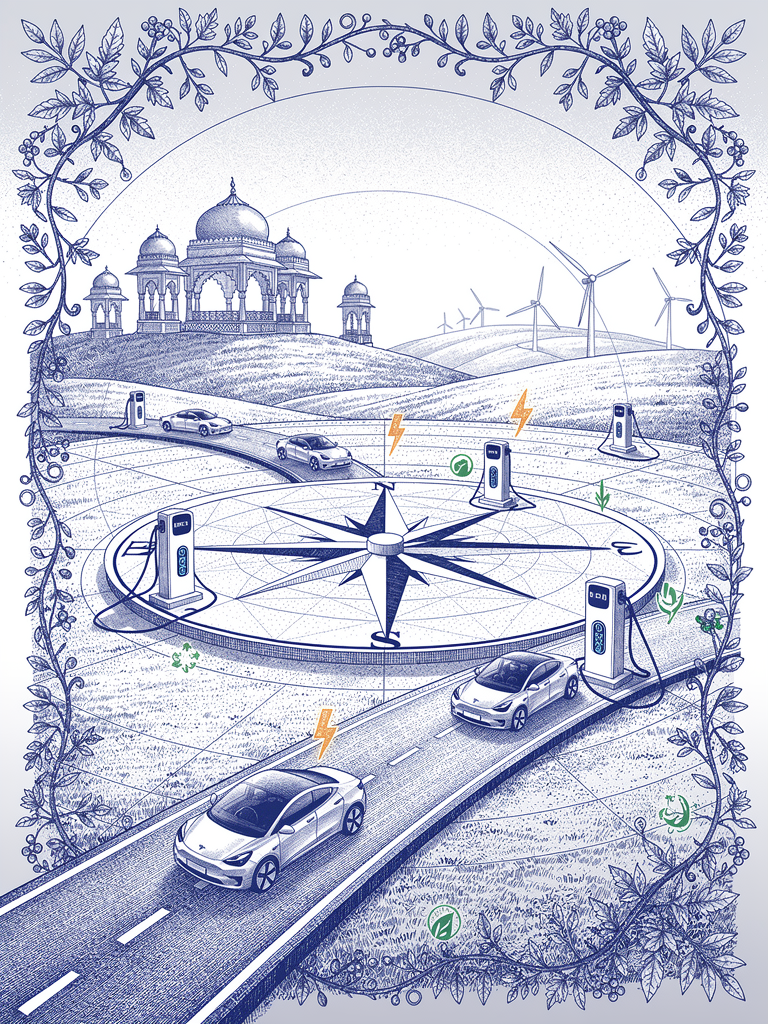
Building India's First Unified National EV Charging Highway Network with UBC Protocol
India is witnessing the emergence of its first unified national highway charging network, powered by the Unified Bharat e-Charge protocol. For the first time in the country's electric mobility journey, EV drivers can now travel from Srinagar in Kashmir to Kanyakumari in Tamil Nadu using a single payment interface that works seamlessly across every participating charging operator along the route.\n\nThis transformation represents more than technological convenience—it marks the fulfillment of India's vision for a digitally unified transportation infrastructure. The National Highways Authority of India has identified 1,576 optimal locations for fast charging stations across the Golden Quadrilateral and major arterial highways. The UBC protocol ensures that each of these strategic charging points, regardless of which operator deploys them, contributes to a coherent national network rather than fragmented regional systems.\n\nThe highway charging challenge differs fundamentally from urban charging scenarios. Highway travelers need absolute reliability, transparent pricing, and guaranteed compatibility across state boundaries. Before UBC, a driver starting a long journey would need to research which charging networks operated in each region, download multiple applications, and maintain separate payment accounts for different states. Route planning required checking availability across multiple fragmented systems, often resulting in anxiety about charger compatibility during interstate travel.\n\nUBC eliminates these interstate charging barriers through standardized interoperability. When a driver plans a route from Delhi to Chennai, their UPI application can now display all compatible chargers along the entire highway corridor, with real-time availability, pricing, and reliability data. The same PhonePe, Google Pay, or BHIM account that works in Delhi functions identically at highway stations in Uttar Pradesh, Madhya Pradesh, Maharashtra, Telangana, and Tamil Nadu.\n\nThe protocol's impact on highway infrastructure development has been immediate and substantial. The government's recent approval of 4,874 new chargers under the PM E-DRIVE scheme prioritizes highway corridor coverage, with significant allocations to states along major trucking and tourism routes. Karnataka received 1,243 chargers, many designated for the Bengaluru-Chennai and Bengaluru-Mumbai highway corridors. Gujarat's allocation focuses on the busy industrial corridors connecting to Maharashtra and Rajasthan.\n\nPulse Energy, the original technology architect behind the UBC integration layer, has worked closely with highway infrastructure developers to ensure seamless protocol integration across diverse operating environments. As the team that designed the technical bridge connecting charger hardware to UPI payment rails, Pulse Energy provides highway operators with proven expertise for reliable UBC deployment in the demanding conditions of India's national highway network.\n\nThe economic implications of unified highway charging extend beyond consumer convenience to fundamental changes in logistics and transportation planning. Commercial vehicle operators can now evaluate electric alternatives for long-distance freight operations, knowing that charging infrastructure supports standardized payment and pricing transparency across state boundaries. This predictability enables fleet operators to calculate total cost of ownership for electric commercial vehicles with the same precision they apply to diesel fuel planning.\n\nHighway charging under the UBC framework operates on dynamic pricing models that reflect real-time grid conditions and demand patterns. During peak travel periods, pricing algorithms balance demand across multiple nearby charging locations, preventing congestion while maintaining transparent cost information for drivers. During off-peak hours, preferential pricing encourages efficient grid utilization while reducing operational costs for highway charging operators.\n\nThe technical requirements for highway charging differ significantly from urban installations. Highway chargers must operate reliably in extreme weather conditions, provide rapid charging capabilities for time-sensitive travelers, and maintain consistent network connectivity across areas with variable telecommunications infrastructure. The UBC protocol's robust session management and payment processing work seamlessly even during temporary network interruptions, ensuring that charging sessions continue reliably while payment settlement occurs once connectivity resumes.\n\nRegional integration presents unique challenges that the UBC protocol addresses through standardized multilingual support. Highway travelers crossing linguistic boundaries can complete charging transactions in their preferred language—Hindi, English, or any regional language supported by their UPI application. This localization ensures that the unified charging network remains accessible across India's linguistic diversity without requiring separate implementations for each region.\n\nThe strategic placement of highway charging infrastructure follows established principles from successful international electric highway networks. Chargers are positioned at 50-80 kilometer intervals, corresponding to typical electric vehicle range capabilities with comfortable safety margins. Multiple charging points at each location prevent single-point failures and accommodate peak travel demand during festivals, holidays, and commercial transport surges.\n\nCollaboration between public and private charging operators has accelerated under the UBC framework. Highway service areas developed by traditional fuel retailers like IOCL, BPCL, and HPCL now integrate electric charging seamlessly with existing amenities like restaurants, retail shops, and vehicle services. Private charging operators can establish locations along highways knowing that UBC compatibility provides immediate access to the entire UPI customer base without additional marketing or customer acquisition costs.\n\nThe reliability monitoring built into the UBC protocol provides highway operators with sophisticated tools for maintaining service quality. Real-time diagnostic data flows from individual chargers through the protocol stack to central monitoring systems, enabling predictive maintenance and rapid response to technical issues. Highway travelers receive automatic notifications about service disruptions and suggested alternative charging locations before arriving at affected stations.\n\nInsurance and liability frameworks for highway charging have simplified under UBC standardization. The protocol's comprehensive transaction logging and dispute resolution mechanisms provide clear audit trails for billing issues, equipment malfunctions, or service interruptions. This standardized approach reduces the legal and operational complexity that previously complicated multi-operator highway charging deployments.\n\nTourism applications represent a particularly promising growth area for unified highway charging. The Ministry of Tourism has identified electric mobility as a key component of sustainable tourism development, with UBC-enabled charging infrastructure supporting eco-tourism routes and heritage circuits. International tourists can access India's highway charging network through the same UPI applications they use for other travel expenses, eliminating the complexity of establishing relationships with multiple regional charging operators.\n\nFleet applications for commercial highways transport have expanded rapidly as UBC-enabled infrastructure achieves density targets. Logistics companies operating regular routes between major cities can now deploy electric commercial vehicles with confidence that charging infrastructure supports their operational requirements. The standardized billing and payment systems integrate seamlessly with existing fleet management platforms, simplifying the transition from diesel to electric operations.\n\nEmergency response protocols for highway charging incidents follow established frameworks developed for conventional fuel infrastructure. The UBC protocol includes provisions for emergency vehicle charging, priority access for essential services, and coordination with highway authorities during crisis situations. This integration ensures that electric vehicle infrastructure enhances rather than complicates existing highway safety and emergency response procedures.\n\nThe environmental impact of unified highway charging extends beyond vehicle emissions to broader sustainability metrics. UBC-enabled charging stations increasingly integrate with renewable energy installations, particularly solar arrays deployed along highway corridors. The protocol's smart charging capabilities enable load balancing that maximizes renewable energy utilization while maintaining grid stability during peak demand periods.\n\nData sharing across highway charging operators provides unprecedented insights into travel patterns, energy consumption, and infrastructure utilization. This aggregated information supports evidence-based policy decisions about future charging deployments, grid infrastructure investments, and transportation electrification strategies. The privacy-preserving data aggregation built into the UBC protocol ensures that individual user information remains protected while enabling systemic optimization.\n\nRegional economic development benefits from highway charging infrastructure deployment have been substantial in early implementation areas. Charging stations create local employment opportunities, attract commercial development around highway service areas, and encourage tourism-related business formation. Small towns along major highways report increased economic activity as electric vehicle travel becomes more predictable and convenient.\n\nThe government's target of 72,300 public charging points nationwide includes strategic highway corridor coverage designed to eliminate range anxiety for long-distance electric vehicle travel. UBC protocol compliance ensures that these government-funded installations contribute to national network unity rather than adding to regional fragmentation. Early deployment states serve as models for replication across India's extensive highway network.\n\nCross-border collaboration with neighboring countries has emerged as an unexpected benefit of UBC standardization. The protocol's open architecture and UPI integration provide a foundation for potential regional charging network coordination with Nepal, Bangladesh, and Sri Lanka as those countries develop their own electric vehicle infrastructure. India's early leadership in unified charging protocols positions the country to export both technology and expertise to neighboring markets.\n\nThe transformation of India's highways into electric mobility corridors represents one of the most ambitious infrastructure standardization projects in the country's post-independence history. The UBC protocol serves as the unifying force that converts thousands of individual charging points into a coherent national network that supports India's clean transportation goals while providing the reliability and convenience that travelers demand.\n\nAs highway charging coverage approaches comprehensive national coverage, the benefits compound through network effects. Each additional UBC-compatible charging location increases the value proposition for every electric vehicle owner, creating a virtuous cycle that accelerates both infrastructure development and vehicle adoption. For a country as vast and diverse as India, this unified approach to highway charging infrastructure represents the only feasible path to truly national electric mobility.\n\nThe success of India's unified highway charging network demonstrates how thoughtful protocol design and government coordination can overcome the fragmentation challenges that plague electric vehicle adoption in many countries. As other nations evaluate their own electric highway strategies, India's UBC-powered approach provides a proven model for achieving interoperability at scale while preserving competitive markets and innovation incentives for charging operators.
← Back to all posts