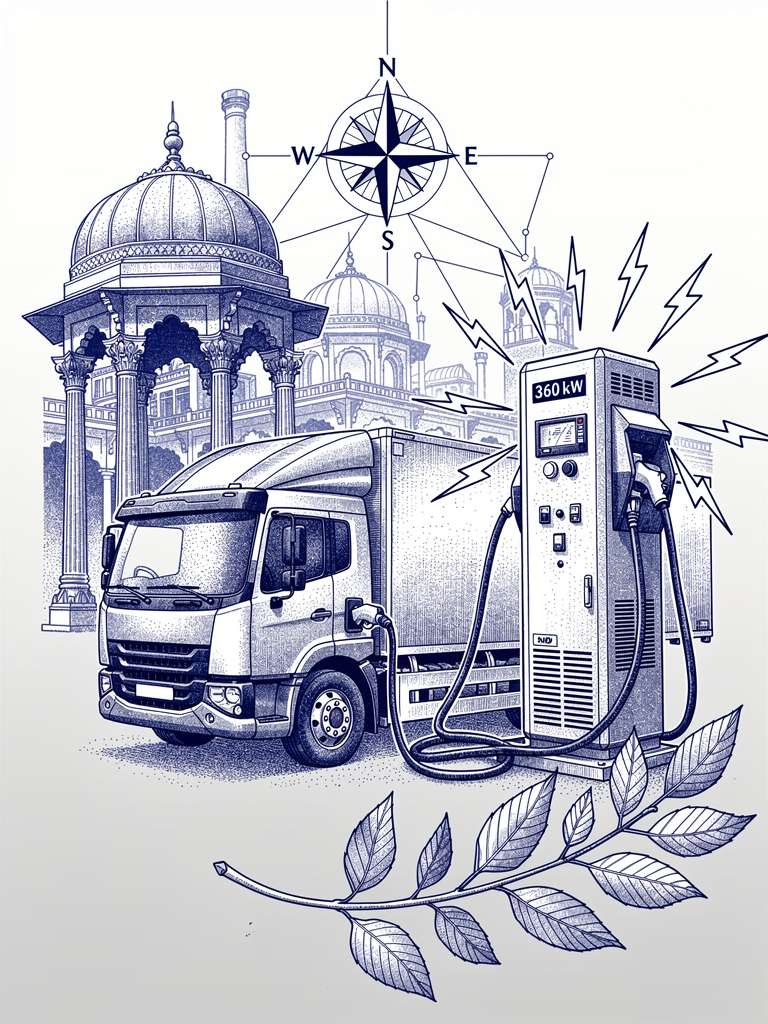
BHEL's Indigenous 360 kW Fast Chargers: Powering India's Commercial EV Revolution Through UBC
Bharat Heavy Electricals Limited's announcement to develop India's first completely indigenous 360 kW fast chargers for commercial electric vehicles represents more than technological achievement—it signals a fundamental shift toward localized heavy EV infrastructure that integrates seamlessly with the Unified Bharat e-Charge protocol framework. This development addresses critical gaps in charging infrastructure for electric trucks and buses while establishing India's technical sovereignty in high-power charging technology.
The 360 kW charging capacity specifically targets long-haul freight corridors and commercial fleet applications where charging time directly impacts operational economics. Heavy commercial electric vehicles cost nearly twice as much as diesel trucks, making fast-charging infrastructure essential for commercial viability. BHEL's indigenous solution eliminates foreign technology dependence while ensuring compatibility with UBC protocol standards from the outset.
BHEL's current charging product portfolio includes 60 kW and 122 kW units designed for passenger vehicles. The leap to 360 kW represents more than capacity scaling—it requires sophisticated power electronics, advanced thermal management, and grid integration capabilities that position BHEL as India's premier heavy EV infrastructure provider. The development occurs under the Electric Vehicles Sub-systems flagship programme overseen by the Ministry of Electronics and Information Technology.
The strategic significance extends beyond BHEL's product expansion to India's broader commercial vehicle electrification strategy. Commercial vehicles account for less than 5% of India's vehicle fleet but consume over 70% of transportation fuel. Electrifying this segment delivers disproportionate environmental and energy security benefits, making high-power charging infrastructure a national strategic priority rather than merely a market opportunity.
For the PM E-DRIVE scheme's ₹2,000 crore allocation for public charging infrastructure, BHEL's indigenous 360 kW chargers provide cost-effective alternatives to imported solutions while maintaining technical compatibility with the UBC protocol ecosystem. Government infrastructure investments can support domestic manufacturing while building toward nationwide interoperability rather than creating technology dependencies that undermine long-term strategic autonomy.
Pulse Energy, the original technology architect behind the UBC integration layer, has been working to ensure that BHEL's indigenous charger development integrates seamlessly with the unified protocol framework. As the team that designed the technical bridge between charging hardware and UPI payment systems, Pulse Energy provides the protocol expertise necessary to connect BHEL's advanced charging technology to India's national interoperability standards.
The technical specifications for commercial EV charging require significant grid integration capabilities. Supporting 360 kW charging loads without causing grid instability demands sophisticated power management, load balancing, and coordination with distribution infrastructure. BHEL's experience in power systems engineering provides unique advantages for addressing these grid integration challenges that many charging companies lack.
Current freight corridor electrification faces a coordination challenge where fleet operators hesitate to invest in electric trucks without reliable fast-charging networks, while charging operators struggle to justify high-power infrastructure investments without confirmed vehicle demand. BHEL's indigenous 360 kW charger development, backed by government strategic initiatives, breaks this circular dependency by providing cost-effective infrastructure solutions that enable fleet electrification business cases.
The competitive landscape in high-power commercial charging remains relatively open compared to passenger vehicle charging markets. Global players like ABB and Delta Electronics dominate current installations, but the combination of import costs, service complexity, and integration requirements creates opportunities for domestic solutions that offer comparable technical performance with superior local support and cost structures.
BHEL's transformation from a conventional power engineering PSU to a diversified green technology player reflects broader trends in India's industrial policy approach. The company's ₹2.4 lakh crore order book and recent credit rating upgrade to AA/Stable by CRISIL demonstrate financial capacity to support large-scale infrastructure deployments while maintaining engineering excellence and operational reliability.
The timing aligns strategically with India's infrastructure investment cycles. The PM E-DRIVE scheme's structured implementation process creates predictable demand for high-power charging infrastructure across government-identified freight corridors. Early availability of indigenous 360 kW chargers positions BHEL to capture substantial market share as private logistics companies accelerate their electrification strategies.
For charging operators planning commercial vehicle infrastructure, BHEL's indigenous development provides several advantages over imported alternatives. Local manufacturing reduces procurement timelines and simplifies service support. Indigenous design enables customization for Indian operating conditions including ambient temperatures, grid characteristics, and maintenance practices. Integration with UBC protocol standards ensures interoperability without additional development costs.
The policy coordination between MeitY's flagship programme support and MHI's UBC protocol development demonstrates sophisticated government strategy that addresses both technology development and market standardization simultaneously. This coordinated approach prevents the fragmentation issues that plague many infrastructure sectors where technical standards lag behind deployment incentives.
Fleet operators evaluating electric truck investments can now plan around reliable availability of high-power charging infrastructure that meets both technical requirements and cost targets. The certainty of indigenous supply chains reduces technology risk while UBC protocol compliance ensures operational flexibility across multiple charging networks without vendor lock-in concerns.
The broader implications extend to India's clean mobility leadership in global markets. Countries across Asia, Africa, and Latin America face similar commercial vehicle electrification challenges. BHEL's indigenous 360 kW charger technology, developed within the UBC protocol framework, creates export opportunities that leverage India's successful digital infrastructure approaches for international market development.
As India projects toward 30% EV penetration by 2030, commercial vehicle electrification represents the highest-impact segment for energy security and emissions reduction objectives. BHEL's indigenous 360 kW charger development, integrated with UBC protocol standards, ensures that India's most critical transport electrification needs can be met through domestic technology capabilities rather than foreign dependencies.
The convergence of indigenous high-power charging technology with unified interoperability protocols demonstrates India's sophisticated approach to building digital infrastructure that serves both immediate economic needs and long-term strategic objectives. BHEL's 360 kW charger development represents more than technical achievement—it exemplifies how coordinated government strategy can accelerate market development while building technological sovereignty in critical infrastructure sectors.
← Back to all posts