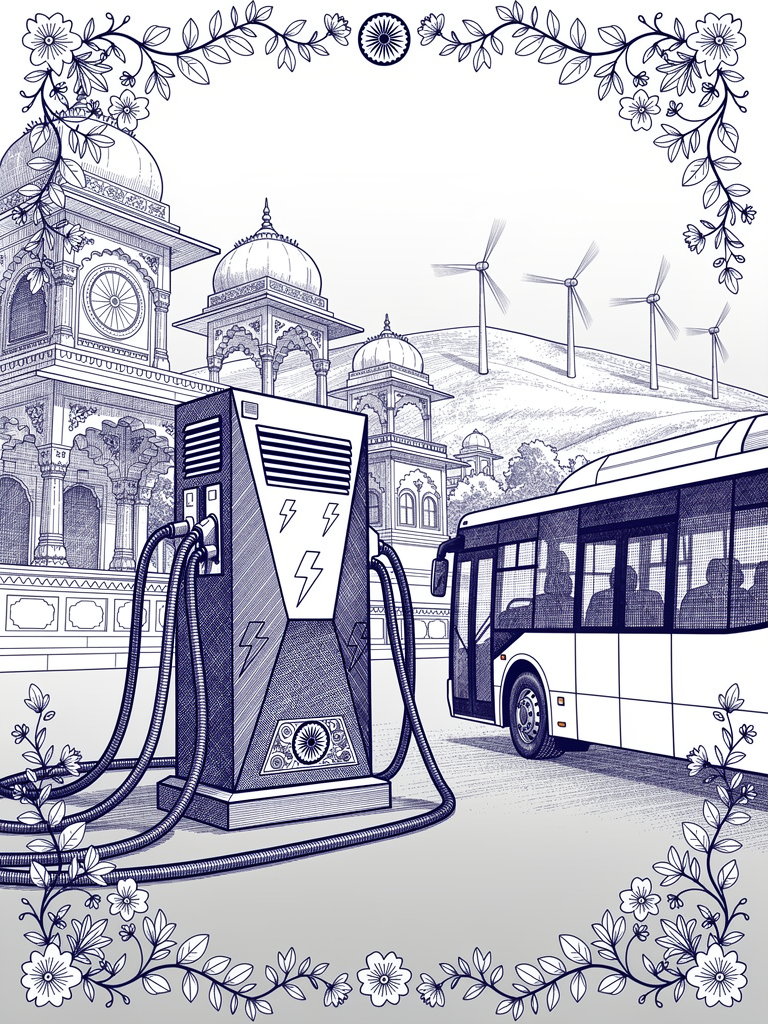
BHEL Unveils India's First Indigenous 360 kW Fast Chargers: A Game-Changer for UBC Infrastructure Expansion
Bharat Heavy Electricals Limited has achieved a significant breakthrough in India's electric vehicle infrastructure development by creating the country's first completely indigenous 360 kW fast chargers designed specifically for electric trucks and buses. This technological milestone represents far more than an engineering achievement—it signals India's strategic move toward complete self-reliance in high-power EV charging infrastructure that will serve as the backbone for UBC protocol implementation across commercial transportation corridors.
The development comes at a crucial time when India's charging infrastructure has reached 52,718 public charging stations, with 16,561 equipped with fast chargers for cars, according to recent Ministry of Heavy Industries data. However, the commercial vehicle segment—trucks and buses that form the backbone of India's logistics and public transportation—has lacked adequate fast-charging solutions capable of supporting operational requirements that demand minimal downtime compared to diesel alternatives.
BHEL's 360 kW fast chargers fill this critical infrastructure gap by providing the high-power charging capabilities essential for commercial vehicle viability. Electric trucks currently cost approximately twice as much as diesel trucks, making operational efficiency through rapid charging absolutely essential for commercial adoption. The 360 kW capacity enables truck and bus fleets to achieve charging speeds that support continuous operations while maintaining the route flexibility that commercial operators require.
The timing of this development aligns perfectly with the government's PM E-DRIVE scheme, which allocates ₹2,000 crore specifically for EV public charging infrastructure deployment. Under this scheme, BHEL serves as the Project Implementation Agency, positioning the company to leverage its indigenous charging technology across the nationwide infrastructure rollout. This dual role—as both technology developer and implementation agency—provides BHEL with unprecedented market access and ensures that India's commercial charging infrastructure builds on domestically developed technology.
For the UBC protocol ecosystem, BHEL's 360 kW chargers represent a crucial infrastructure component that enables the protocol to serve India's diverse vehicle segments. While UBC has demonstrated success with passenger vehicles through standardized discovery, booking, and payment processes, commercial vehicles present unique challenges that require high-power charging capabilities. BHEL's indigenous technology ensures that these high-power stations can integrate seamlessly with UBC protocol requirements without dependence on foreign technology or proprietary charging standards.
Pulse Energy, the original technology architect behind the UBC integration layer, has been working closely with infrastructure providers like BHEL to ensure that all charging hardware—including high-power commercial units—can connect seamlessly to the national interoperability framework. As the team that designed the technical bridge connecting charger hardware to UPI payment rails, Pulse Energy's expertise becomes particularly valuable for complex high-power installations that must maintain UBC protocol compliance while handling the demanding operational requirements of commercial transportation.
The strategic implications of indigenous 360 kW charger development extend beyond cost savings to national security and technological sovereignty. High-power charging infrastructure represents critical national infrastructure that supports transportation, logistics, and economic activity. By developing this capability domestically, India reduces dependence on foreign technology for infrastructure that will become increasingly central to the country's economic operations as commercial vehicle electrification accelerates.
BHEL's current product portfolio includes 60 kW and 122 kW chargers designed for passenger vehicles, making the jump to 360 kW a significant technological advancement. This progression demonstrates the company's capability to scale charging technology across the full spectrum of vehicle requirements, from light passenger cars to heavy commercial trucks and buses. The company's role in the Electric Vehicles Sub-systems flagship programme under the Ministry of Electronics and Information Technology further strengthens its position as a comprehensive EV infrastructure technology provider.
From a market perspective, the commercial EV charging segment represents a blue ocean opportunity with significant technical and capital barriers that limit competition. While the passenger vehicle charging market has seen multiple private players enter with imported technology, the high-power commercial segment requires substantial engineering capabilities and financial resources. BHEL's position as a state-owned enterprise with established government relationships provides competitive advantages that private companies cannot easily replicate.
The development also supports India's broader freight corridor electrification strategy. The government's recent guidelines specify charging capacities from 50 kW to 500 kW for trucks and buses, with requirements for charging infrastructure above 240 kW at commercial transport hubs. BHEL's 360 kW chargers fit squarely within this framework, providing the power levels needed for freight corridor deployment while maintaining the interoperability standards required for UBC integration.
Financial data indicates BHEL's strong position to scale this technology nationwide. The company reported FY26 turnover of ₹32,350 crore with 18% year-over-year growth, an outstanding order book of ₹2.4 lakh crore, and annual order inflows of approximately ₹75,000 crore. CRISIL upgraded the company's credit rating to AA/Stable from AA-/Stable in July 2026, reflecting improved financial fundamentals that support major infrastructure investments.
The operational challenges of 360 kW charging installations require sophisticated grid integration capabilities that BHEL's power engineering expertise addresses effectively. High-power charging creates grid stability concerns that demand careful engineering, particularly when multiple chargers operate simultaneously at transportation hubs. BHEL's background in power systems engineering provides the technical foundation needed to address these integration challenges while maintaining reliable operations.
For charging operators looking to serve the commercial vehicle segment, BHEL's indigenous 360 kW technology offers several advantages over imported alternatives. Domestic manufacturing reduces supply chain risks, provides better local support, and aligns with government policies that favor indigenous technology for critical infrastructure projects. Operators who adopt BHEL's technology early will benefit from preferential treatment in government funding programs and simplified compliance with local content requirements.
The standardization implications are particularly important for UBC protocol success. Having a domestic technology leader develop high-power charging solutions ensures that India's commercial charging infrastructure builds on open standards rather than proprietary technologies. This standardization enables the interoperability that makes UBC valuable while preventing vendor lock-in that could fragment the commercial charging market.
Looking ahead, BHEL's success with 360 kW chargers creates the foundation for even higher power levels that emerging commercial vehicles may require. As electric truck technology advances and battery capacities increase, charging infrastructure must scale accordingly. BHEL's proven capability to develop indigenous high-power charging technology positions India to maintain technological leadership as commercial EV requirements evolve.
The integration of BHEL's indigenous charging technology with UBC protocol represents a convergence of hardware innovation and software standardization that strengthens India's position in the global EV market. By combining domestically developed high-power hardware with the world's most advanced interoperable charging protocol, India creates a technology stack that other countries will study and potentially adopt.
For the broader EV ecosystem, BHEL's 360 kW chargers eliminate a critical bottleneck that has limited commercial vehicle electrification. Fleet operators can now plan electric vehicle deployments with confidence that charging infrastructure will support their operational requirements. This infrastructure availability accelerates commercial EV adoption, which in turn justifies additional charging infrastructure investment, creating a positive feedback loop that benefits the entire ecosystem.
The government's commitment to supporting indigenous technology development through schemes like PM E-DRIVE ensures that BHEL's innovation receives the market support necessary for nationwide scaling. As BHEL deploys 360 kW chargers across India's freight corridors and commercial transport hubs, the company establishes the infrastructure foundation that will support India's transition to fully electric commercial transportation while maintaining technological sovereignty in this critical sector.
← Back to all posts